

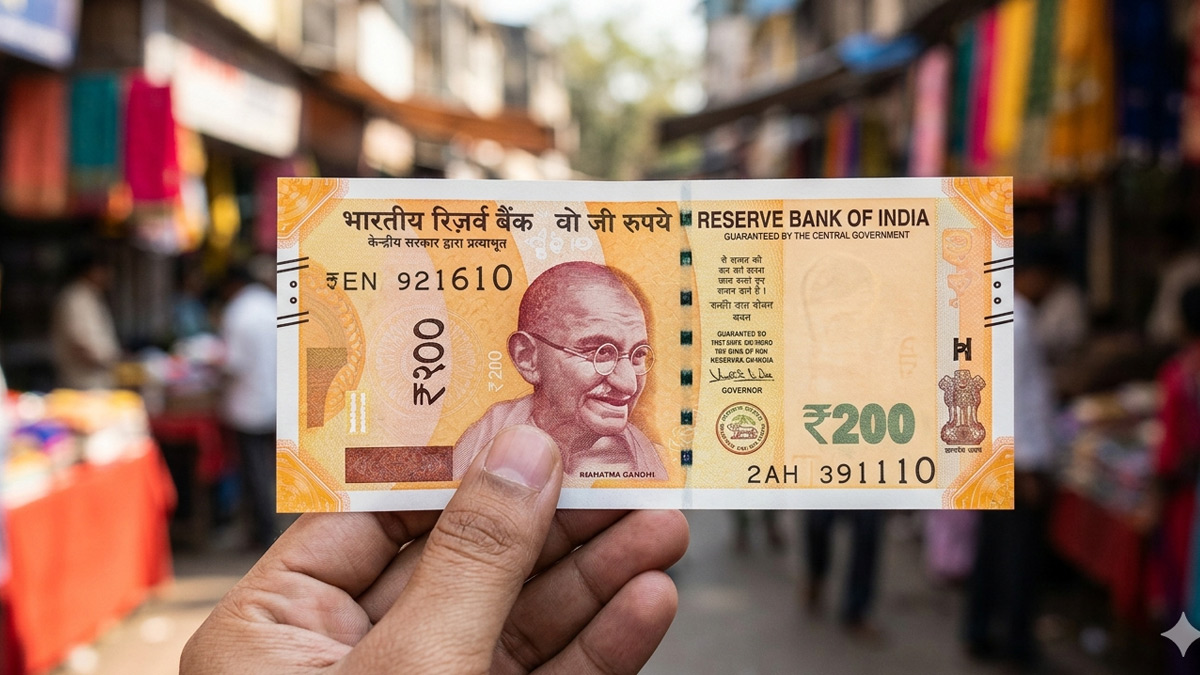
NEW DELHI: India loves to celebrate its digital payments revolution. Fruit vendors flash QR codes, auto-rickshaw drivers track real-time bank settlements, and peer-to-peer transfers happen in seconds. Yet beneath this gleaming digital surface, something unexpected is happening: India’s currency in circulation has quietly surged to a record Rs 42.86 trillion.
The mainstream press has framed the RBI’s decision to revive polymer banknotes as a routine cost-cutting exercise. It is anything but. The push for plastic currency is not a sign that India’s digital transition has stalled. It is the direct consequence of it.
Cash on steroids
UPI did not kill physical cash. It filtered it. High-value transactions such as rent, appliances and big-ticket purchases migrated to digital apps. What remained in people’s hands was low-denomination, high-velocity cash, cycling through local transport, daily wages and street commerce at a ferocious pace. A Rs 100 note that once sat quietly in a wallet for weeks now changes hands multiple times a day, passing from a sweaty palm to a greasy cash drawer to a torn pocket within a single afternoon.
The result: cotton-paper notes are being destroyed faster than ever. The RBI’s annual printing bill hit Rs 6,372.8 crore in 2024-25, up from Rs 5,101.4 crore the year before. Some 23.8 billion soiled banknotes were destroyed in the same period, a 12.3 per cent jump year-on-year. India is not hoarding cash. It is simply wearing it out at an extraordinary rate.
Polymer notes, which last several times longer than paper, are the RBI’s structural response, an engineering upgrade for an era where physical currency must survive continuous, punishing use.
The folding problem
Most countries that adopted polymer notes, including Australia, Canada and Britain, rolled them out across all denominations at once. India cannot simply do the same. Indian cash faces conditions that western central bankers rarely consider. Notes are folded into tight squares, rolled and tucked, pinned to clothing. Cotton-paper absorbs these shapes; polymer springs back, sliding out of pockets and resisting the creases that Indian consumers rely on.
Fresh polymer notes also carry a slight static charge, causing them to stick together, a serious problem in the crowded wholesale markets of Delhi or Mumbai, where vendors count thick wads of cash by hand and cannot afford to hand over two notes for the price of one.
The RBI is expected to focus its pilot on lower denominations, Rs 10, Rs 20 and Rs 100, precisely because of these behavioural quirks. For the foreseeable future, Indians will carry a hybrid wallet: soft, foldable paper notes alongside slick, rigid plastic ones. Retail banking, cash-sorting machines and consumer wallets will all have to adapt.
The ATM problem, solved
When India first attempted a polymer pilot in 2013, the project collapsed because ATMs could not handle the material. Plastic has entirely different friction coefficients from paper; standard rubber rollers would jam or grab multiple sheets at once. The technology simply was not ready.
It is now. India’s network of more than 250,000 ATMs has undergone a quiet but significant overhaul. Modern machines equipped with optical thickness sensors and variable-tension rollers can handle a hybrid stream of paper and polymer notes simultaneously. The RBI’s renewed confidence is, in large part, a bet on this upgraded infrastructure.
The geopolitics of plastic
There is a dimension to this story that has gone almost entirely unreported. India’s cotton-paper currency supply chain is deeply sovereign, anchored by domestic security paper mills such as the facility at Hoshangabad. Switching to polymer means entering a specialised global market dominated by a handful of players, most notably CCL Secure, the maker of Guardian polymer substrate used by central banks worldwide.
For a government that has staked its industrial policy on self-reliance, that dependency is uncomfortable. The RBI’s pilot is therefore also a test of whether India can build a secure, localised supply chain for security-grade plastic substrate, insulating its money supply from global shocks and keeping the entire operation firmly within Indian borders.
A two-tier system by design
None of this should be read as a retreat from India’s digital ambitions. The RBI has simply accepted a truth that the cheerleaders of cashless economies have long resisted: physical cash is not going away. It serves as a financial safety net, an anonymous medium of exchange and a tool for inclusion in an economy where hundreds of millions remain outside the formal banking system.
India is not choosing between paper and pixels. It is building a two-tier financial system, one in which digital networks handle speed and scale while durable, polymer-reinforced cash handles everything else. The plastic note is not the end of India’s digital revolution. It is proof that the revolution has grown up.