
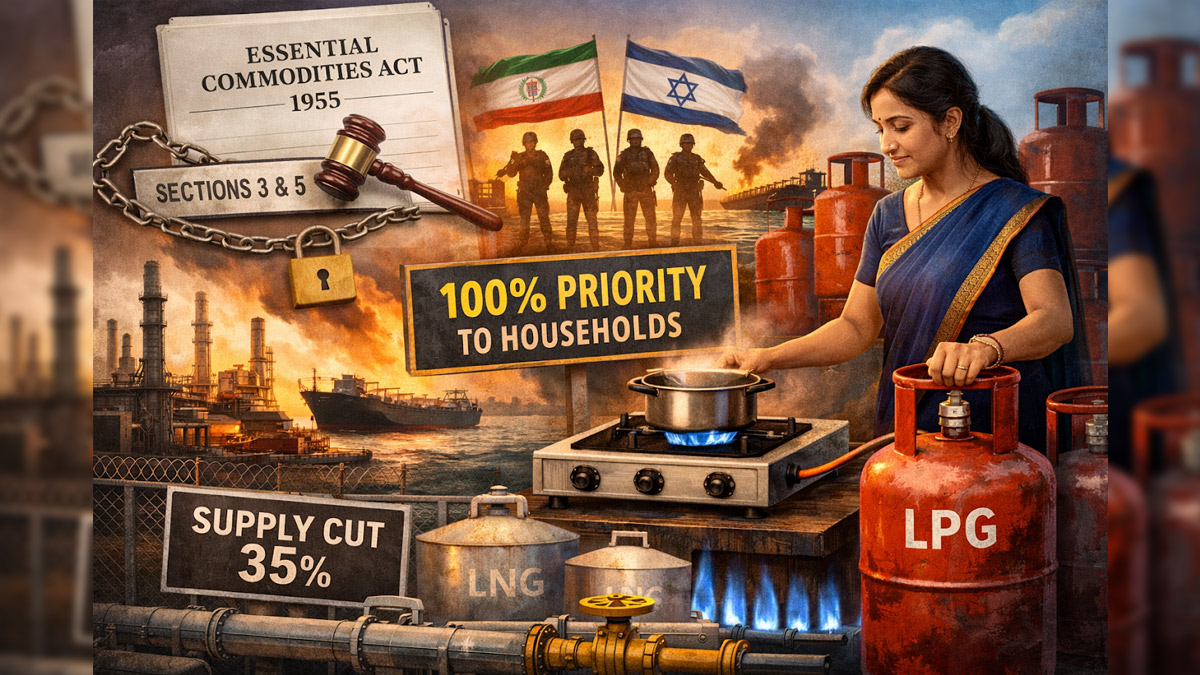
NEW DELHI: India has reached for one of its most powerful economic levers. As geopolitical tensions in West Asia choke critical shipping lanes, the government has invoked the Essential Commodities Act, 1955, to keep kitchens burning and prices in check.
The move follows a sharp disruption in global energy flows after conflict involving the United States, Israel and Iran unsettled shipping through the Strait of Hormuz — one of the world’s most strategic oil and gas corridors. With India importing more than 60 per cent of its liquefied petroleum gas (LPG) and a large share of its liquefied natural gas (LNG), the squeeze has quickly turned into a domestic supply crunch.
To steady the market, the Ministry of Petroleum and Natural Gas invoked the Essential Commodities Act (ECA) on March 10. This is a sweeping law that allows the state to regulate the production, supply, distribution and pricing of goods considered vital to everyday life.
What is the Essential Commodities Act?
The Essential Commodities Act, 1955, is a central legislation designed to ensure the steady supply of goods that are vital for the general public’s daily life. It allows the government to control the production, supply, distribution, and pricing of specific commodities.
Key features of the Act
Defining “Essential”: The Act provides a schedule of commodities (such as food, drugs, fuel, and fertilisers) that the government can regulate. The Centre has the power to add or remove items from this list as needed.
• Preventing Hoarding: It allows the government to impose stock limits on traders and wholesalers, preventing them from creating “artificial” shortages to hike prices.
• Price Regulation: The government can fix a maximum retail price (MRP) for these goods to protect consumers from exploitation.
• Enforcement: Violations can lead to imprisonment (ranging from three months to seven years), fines, and the confiscation of illegally stored goods.
Why has it been invoked recently?
On 10 March 2026, the Ministry of Petroleum and Natural Gas invoked the ECA to address a severe crunch in Liquefied Petroleum Gas (LPG) and Natural Gas.
1. Geopolitical Disruption
The ongoing conflict in West Asia has effectively halted vessel movements through the Strait of Hormuz. Since India imports over 60% of its LPG and a significant portion of its Natural Gas (LNG), this blockade has triggered a massive supply deficit.
2. Prioritising Households
The government issued a Natural Gas (Supply Regulation) Order, 2026, which establishes a priority framework for gas distribution. Under this order:
• Priority 1: 100% of available gas is diverted to domestic piped gas (PNG), transport fuel (CNG), and household LPG production.
• Priority 2: Fertilisers receive 70% of their usual supply.
• Non-Priority: Industrial and commercial sectors (including refineries and petrochemical units) have seen their allocations cut by 20% to 35% to safeguard the needs of the common citizen.
How it helps the country
The invocation of the ECA acts as a “safety valve” for the economy during a crisis.
• Social Stability: By ensuring that domestic kitchens continue to have cooking gas (LPG), the government prevents public unrest and protects the poorest households.
• Curbing Inflation: Despite the supply crisis, the Act allows the government to manage price volatility. While a price hike of ₹60 per cylinder was recorded in March 2026, the Act prevents speculative traders from doubling or tripling prices during the shortage.
• Energy Security: By forcing refineries to stop using propane and butane for petrochemicals and instead convert them into LPG, the country maximizes its limited internal resources.
The impact on the public and industry
While the Act helps the average consumer, it has varied effects across different sectors:
1. For the General Public
The immediate benefit is the 100% assured supply of gas for homes and transport. To prevent panic-buying, the government has introduced a 25-day inter-booking period, meaning households cannot order a second cylinder immediately after the first, thus discouraging hoarding.
2. For Industry and Businesses
The impact here is more challenging.
• Hospitality: Many restaurants and hotels are facing shortages of commercial LPG, with some in major cities like Mumbai and Bengaluru reporting temporary closures.
• Petrochemicals: Refineries have been prohibited from using certain hydrocarbon streams for industrial production, which may lead to a temporary spike in the cost of plastic and chemical derivatives.
India’s latest invocation of the Essential Commodities Act centres on key fuels — LPG, natural gas, PNG and CNG — after supply chains were disrupted by the West Asia conflict and the effective blockade of the Strait of Hormuz. Under the government’s directive, 100 per cent of available gas supply has been prioritised for households, while industrial sectors face cuts of up to 35 per cent to conserve fuel for essential use. The order has come into force with immediate effect and will remain in place until further notice, enforced under Sections 3 and 5 of the Essential Commodities Act, 1955, which empower the government to regulate supply and distribution during a crisis.
By tightening control over essential fuels and redirecting scarce gas to homes, the government is trying to keep kitchens running and prices stable. Whether the squeeze eases soon will depend on geopolitics far beyond India’s shores. Until then, the Essential Commodities Act remains the country’s blunt but effective shield against a volatile world.