
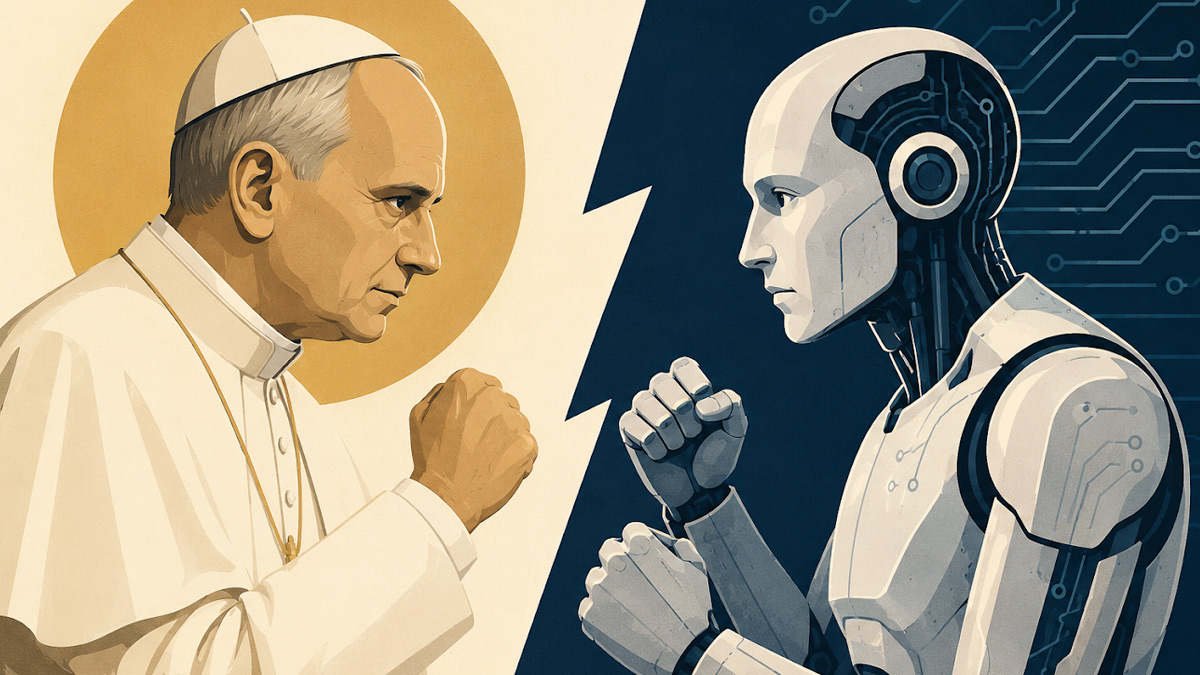
VATICAN CITY: From sermons to silicon, the Vatican has entered the AI debate with unusual force. Pope Leo XIV has issued a sweeping encyclical titled Magnifica Humanitas, warning that humanity’s race to develop artificial intelligence is accelerating faster than its moral safeguards.
Spanning nearly 43,000 words, the document marks the most extensive intervention yet by the Catholic Church on AI and emerging technologies. Widely regarded as the highest form of papal teaching, the encyclical frames artificial intelligence not merely as a technological issue, but as a defining moral and spiritual challenge of the modern era.
Since becoming the first US-born pope, Leo XIV has repeatedly identified AI as “the biggest challenge facing humanity today”. In the encyclical, he urges governments and technology companies to slow down development, warning that commercial competition and geopolitical rivalry are overtaking ethical responsibility.
“Artificial Intelligence now demands to be disarmed,” the Pope wrote, arguing that the technology risks becoming an “instrument of domination, exclusion and death” if left unchecked.
At the heart of the document is a direct attack on autonomous warfare systems. Pope Leo declared it morally unacceptable to allow algorithms to make irreversible life-and-death decisions, warning that AI-powered weapons have advanced beyond meaningful human oversight.
In one of the encyclical’s most striking passages, the Pope argued that the Church’s long-standing “Just War” doctrine no longer adequately addresses the scale and speed of destruction enabled by AI-driven warfare. According to the pontiff, modern conflict risks becoming dangerously detached from human suffering as machines increasingly automate violence.
The document also takes aim at the concentration of AI power within a handful of large corporations. Pope Leo criticised what he described as the excessive accumulation of data, influence and decision-making authority in private hands, calling for stronger legal frameworks, independent oversight and greater political accountability.
“A more moral AI is not enough if that morality is determined by a few,” the encyclical states.
Beyond boardrooms and battlefields, the Pope also highlighted the often invisible labour powering the AI economy. The document condemns exploitative working conditions linked to data annotation, hardware manufacturing and rare earth mining, including the use of child labour in supply chains supporting AI infrastructure.
“The bodies of these people are scarred, injured and worn down so that computational flow may continue uninterruptedly,” the Pope wrote.
Economic disruption caused by automation also features heavily in the text. Pope Leo argued that profit motives cannot justify the systematic erosion of human livelihoods and insisted that economic systems must remain subordinate to human dignity.
To anchor his warning in scripture, the Pope repeatedly invokes the Tower of Babel, comparing today’s AI arms race to humanity’s biblical attempt to reach heaven through unchecked ambition and pride.
He urged technology leaders to “abandon the construction of yet another Tower of Babel”, cautioning that innovation without humility risks social fragmentation and moral confusion.
The encyclical has already triggered reactions across the technology and political worlds.
Notably, the Vatican presentation included Christopher Olah from Anthropic, who acknowledged the immense commercial pressure facing AI companies and welcomed stronger external scrutiny.
The document could also sharpen tensions with deregulation-focused political approaches, particularly those associated with Donald Trump and others who argue that limiting AI development could weaken national competitiveness.
Still, Pope Leo closed the encyclical on a deeply personal note, reminding ordinary citizens that responsibility for AI’s future does not rest solely with governments or corporations.
“Certainly, not everyone has the same power to make a difference,” he wrote. “Yet, no one is without responsibility.”
For a Vatican often associated with centuries-old traditions, the message was unmistakably aimed at the future: humanity may be building smarter machines, but it cannot afford to lose its moral compass in the process.