
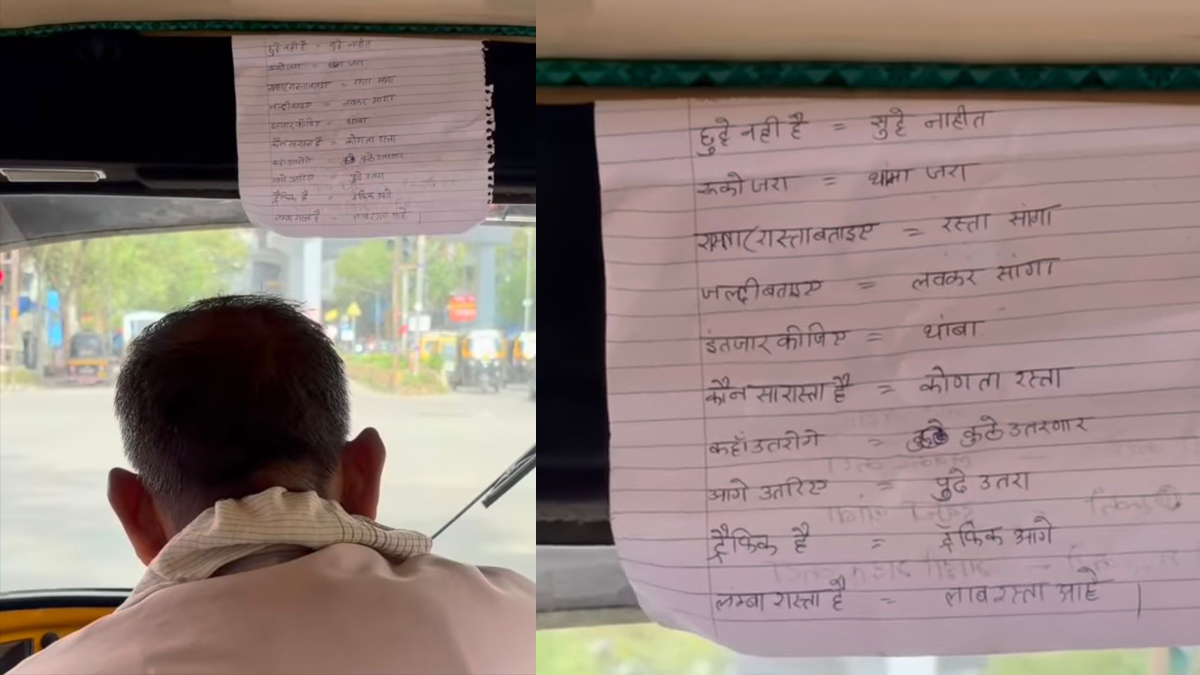
MUMBAI: Policy fights make headlines, but it is often the small, improvised workarounds that reveal how a rule actually plays out on the street. A Mumbai auto-rickshaw driver has become an unlikely case study in exactly that, after a photograph of his handwritten cheat sheet, taped inside his cabin, began doing the rounds online.
The sheet is refreshingly unglamorous. It runs through commonly used Hindi phrases alongside their Marathi translations, the sort of everyday exchanges a driver has with passengers dozens of times a day. Chhutte nahi hain becomes Chhutte nahit, Ruko zara becomes Thamba jara, Rasta bataiye becomes Rasta sanga, and so on down a list built entirely around function over fluency, precisely what the state has been asking for.
That context matters. Maharashtra’s Transport Department began a statewide assessment on August 20 of working Marathi knowledge among non-Marathi-speaking drivers, following an April announcement that auto, taxi and app-based cab drivers would need basic proficiency. The requirement did not land smoothly. Protests broke out in parts of Mumbai on Monday amid enforcement rumours, with some drivers reportedly discouraging others from carrying passengers during the morning rush, disruption serious enough that chief minister Devendra Fadnavis stepped in to clarify that the government wanted functional communication, not fluency, and the state has since granted a one-year extension after auto and taxi unions met him at Sahyadri Guest House.
Against that backdrop of protests, deadlines and union negotiations, one driver’s low-tech solution stands out for its sheer practicality. No classroom, no certificate, just a handwritten sheet built from the phrases he actually needs on the job, updated in real time through conversations with passengers. It is worth noting that plenty of drivers have gone the formal route too. Deputy chief minister Eknath Shinde distributed completion certificates to around 20,000 auto and taxi drivers who finished a Marathi course in Mumbai, just a day before this driver’s sheet began circulating, suggesting the two approaches, structured training and street-level improvisation, are running in parallel rather than in competition.
Whether or not the sheet becomes a template for others, it offers a rather charming reminder that language policy, however contentious in negotiation rooms, often gets solved in the most human and unglamorous way possible: one handwritten phrase at a time.