
MUMBAI: India has always had a genius for inheriting things from the British and making them entirely its own. The gymkhana is perhaps the finest example.
What began as a colonial retreat, a place where sun-baked British officers could escape the heat, the dust, and frankly the locals, has spent the better part of 150 years transforming itself into something the empire never intended: an Indian institution. Complete with its own hierarchies, its own snobberies, its own waiting lists that stretch longer than most mortgages, and its own deeply complicated relationship with the government land it has been sitting on, very cheaply, for a very long time. That relationship is now, rather publicly, under review.
It took a single government letter to do what 150 years of public debate could not: force India’s most exclusive clubs into an uncomfortable spotlight. In late May 2026, the Union Ministry of Housing and Urban Affairs served an eviction notice on the Delhi Gymkhana Club, ordering it to vacate its 27-acre Lutyens’ Delhi estate by 5 June, citing the need to secure the land for defence infrastructure. The club, it emerged, had been paying an annual rent of Rs 1,000 for this prime real estate sitting right beside the Prime Minister’s residence. Not per square foot. Not per month. Per year.
The notice ricocheted immediately. Maharashtra reviewed its Marine Drive gymkhana leases. The Union Minister stated publicly that more reclamations would follow. Club secretaries across the country quietly reached for their files. The eviction itself may yet be tied up in litigation for years. But the conversation it has cracked open is considerably harder to close. For the first time in a long while, ordinary Indians are asking a perfectly reasonable question: what exactly are these places, how did they end up on public land, and why has nobody thought to ask sooner?
To answer that, it helps to start with the name, because the name gives the whole game away. “Gymkhana” is a magnificent mongrel of a word. Linguists trace it most convincingly to the Hindi “Gend-khana,” meaning a ball-house, blended with the English “gymnasium” and possibly the Persian “Gyan-khana,” a place of knowledge or a court for ball games. The result is a word that sounds authoritative, slightly exotic, and entirely impossible to pin down, which, as it happens, describes these institutions rather well.
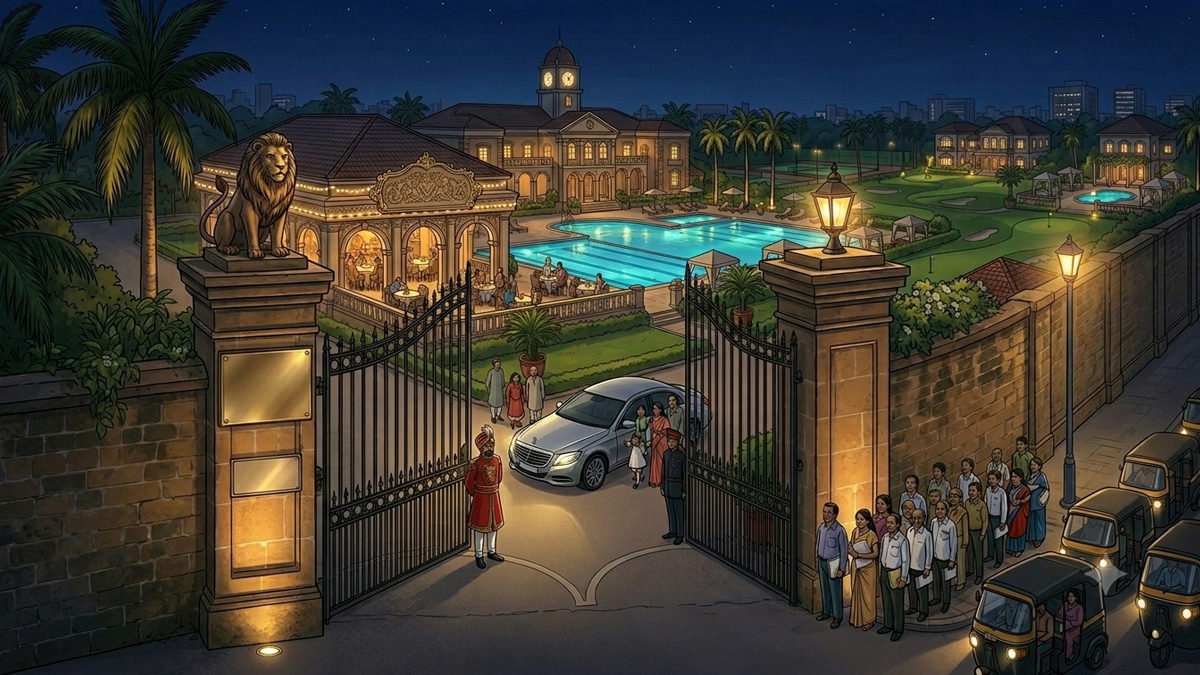
The British took this hybrid word and attached it to a very specific idea: a members-only sporting and social club, built on prime real estate, for people who had decided they deserved prime real estate. The first gymkhanas appeared across India in the mid-to-late 19th century, established in garrison towns, colonial capitals, and trading ports wherever the British had planted themselves firmly enough to want somewhere pleasant to spend a Sunday afternoon. Their purpose was not subtle. These were spaces for British military officers and civil servants to play cricket, polo, billiards, and tennis; to drink; to gossip; and to exist in comfortable separation from the Indian population that surrounded them on all sides. The gymkhana was, in architecture and in policy, a wall. A very well-maintained wall, with a good cellar and a billiards table.
The British did not anticipate what happened next. Excluded from the gymkhanas, India’s wealthy and socially ambitious communities did what they have always done when shut out of something: they built their own version, and in many cases built it better. Along Bombay’s Marine Drive, a remarkable row of gymkhanas emerged in the late 19th and early 20th centuries, each founded by a different community and each carrying a quiet declaration of dignity in its very existence. The Parsi Gymkhana, the PJ Hindu Gymkhana, the Islam Gymkhana, the Catholic Gymkhana, the Bombay Gymkhana. They lined up along the seafront, each one a statement that read: if you will not let us in, we will build something worth being let into.
These were not mere sports clubs. They were community anchors. They gave Indian cricketers places to train and play at a time when colonial clubs were closed to them. Several of India’s early Test cricketers honed their games on gymkhana grounds. The Bombay Quadrangular, one of the most celebrated cricket tournaments of the pre-Independence era, was organised along gymkhana community lines, with teams representing the Hindus, Muslims, Parsis, and Europeans. Cricket and community identity, played out on government-leased turf.
Elsewhere, the map of elite clubs was filling in with similar ambition and similar arrangements. In Delhi, the Delhi Gymkhana Club was established in 1913 on 27 acres of what would become some of the most valuable land in Asia. In Bengaluru, the Bangalore Club had been going since 1868, already distinguished enough to count a young Winston Churchill among its members, and already owed Rs 13 by him, a bar bill he settled by simply leaving India and never looking back, and which the club has carried in its ledgers ever since with the pride of an institution that knows a good story when it inherits one. In Chennai, the Madras Club, founded as far back as 1832, was quietly becoming the second oldest surviving club in India, and making no particular effort to let anyone forget it. By Independence in 1947, India had inherited an extraordinary network of these institutions: some British-founded, some community-founded, all sitting on prime government land, all operating on lease terms that reflected the economics of an entirely different century.
What is remarkable about the post-Independence gymkhana story is how little changed, and how quickly the new Indian elite stepped into the shoes the departing British had left behind. The clubs did not close. They did not democratise. They did not throw open their gates to the general public on whose land they technically sat. Instead, they did something rather more elegant: they swapped one exclusive membership for another. Out went the British officers and their wives. In came the IAS officers, the industrialists, the old political families, the judges, the senior diplomats. The waiting lists appeared. The dress codes tightened. The annual rents, fixed at whatever they had been in the colonial era, stayed fixed.
The Delhi Gymkhana’s waiting list grew to 37 years. Thirty-seven years. A child born to a member who joins the waiting list today will be eligible to use the pool when they are old enough to have children of their own. The Breach Candy Club in Mumbai, founded in 1876 for Europeans only, occupies a sweeping beachfront plot in south Mumbai and remains one of the most impenetrable membership organisations in the country, requiring not just considerable wealth but the right social genealogy, the right connections, possibly the right school tie. The Delhi Golf Club spread itself across 170 acres of central New Delhi, an area larger than many Indian villages, becoming the preferred terrain for the political and corporate elite while enclosing, within its private grounds, protected historical monuments under the Archaeological Survey of India, ancient structures that belong in theory to every Indian citizen but are in practice inaccessible behind membership gates. The Madras Club, sitting on lush acreage along the Adyar River, maintained its strict dress code and restrictive membership process with its air of absolute imperviousness to the passage of time. Founded in 1832, it has now been exclusive for nearly two centuries, which is, by any measure, an impressive commitment to the bit.
Underlying all of it was an economics that was, once you looked at it directly, rather startling. These clubs sit on government land, held on leases negotiated in a different era, at rents revised with all the urgency of a man who has no particular reason to hurry. The Mumbai gymkhanas along Marine Drive occupy some of the most scenically and commercially valuable real estate in the country. Their lease rents, in most cases, have not kept pace with a property market that has appreciated many hundreds of times over since Independence. None of this was secret. Everyone knew. The gymkhana members knew, naturally, and had no particular incentive to raise the subject. The governments knew, and found the clubs useful enough as places to park their own officers and officials, that the conversation was perpetually deferred. The public, largely, was simply not invited to have an opinion on the matter because the public was, as always, not invited at all. What changed, eventually, was the political calculus.
The Delhi Gymkhana’s troubles, it should be noted, did not begin with the eviction notice. The club’s elected board had already been suspended and replaced by a government-appointed committee following allegations of financial mismanagement and opacity in its membership processes. The government had not merely knocked on the door. It had walked in some time ago and begun rearranging the furniture. The eviction notice simply told the furniture to leave as well. In Mumbai, the Maharashtra Government moved to review lease agreements across the Marine Drive gymkhanas, mandating a five per cent membership quota for IAS and Grade-I government officers alongside significant hikes in stamp duty and lease rents. The message was polite but unmistakable: the terms of the arrangement are changing.
It would be too simple, and not entirely fair, to dismiss the gymkhanas purely as relics of colonial privilege squatting on public land. The story, as with most Indian stories, is more tangled than that. These institutions genuinely shaped Indian sport. The cricket that emerged from the Bombay gymkhanas fed directly into some of the greatest batting talent the country has produced. The social networks formed in gymkhana dining rooms played real roles in the formation of post-Independence India’s business and political life. The clubs preserved green spaces in cities that are rapidly running out of them, though this argument carries a rather hollow ring when those green spaces are accessible to perhaps 0.001 per cent of the city’s population. They also evolved, somewhat. Women were admitted, eventually. The community identity that had defined the Mumbai gymkhanas softened over time, becoming less about religious community and more about social status. The waiting lists, paradoxically, grew longer as the clubs grew nominally more open, a reliable sign that demand for exclusivity does not diminish when the criteria for exclusivity change. What they did not do, in most cases, was reckon seriously with the fundamental question of what it means to occupy public land as a private enclave in a democratic republic.
The 2026 controversy has forced that reckoning into the open, and it is unlikely to be resolved quickly or quietly. Outright closure and return of land to public use is also probably the least likely outcome. These clubs have lawyers, members who are themselves senior lawyers, and lease documents constructed with considerable care. More probable is the model the government has already been testing: management takeover, forcing institutional change from within rather than eviction from without. There is also a middle path that some gymkhanas may choose themselves, if they are wise: voluntary reform, opening facilities to the public on certain days, reducing waiting lists, revising membership criteria, contributing meaningfully to the communities whose land they occupy. Whether they do so may determine whether the gymkhana survives the next fifty years as a living institution or becomes a museum piece, preserved under glass, accessible to no one, like the ASI monuments quietly mouldering behind the Delhi Golf Club’s gates.
The gymkhana, in the end, tells a very Indian story about inheritance. The British built these places to assert who belonged and who did not. Indians took them, adapted them, and used them to assert exactly the same thing, just with a different guest list. The land stayed cheap. The gates stayed shut. The waiting lists got longer. Now the government is at the gate, and it is not on the waiting list. What happens next will say something important, not just about these clubs but about India’s relationship with the colonial architecture it has been living inside for eight decades. The gymkhana was never just a sports club. It was always a negotiation about who deserves space, and who gets to decide. That negotiation, deferred for 150 years, is finally, unmistakably, under way.