

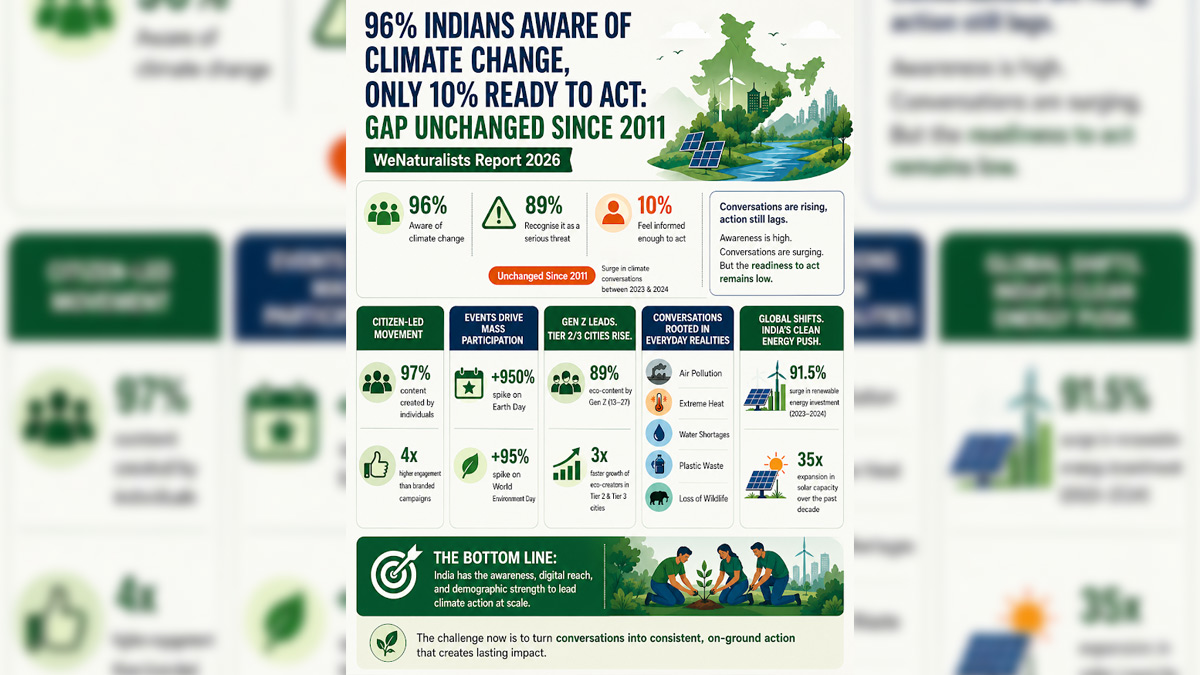
MUMBAI: If climate change had a comment section, India would be trending but not necessarily moving. A new report by WeNaturalists, titled India’s Climate Conversations & Action Report 2026, highlights a stark disconnect between awareness and action. While 96 per cent of Indians are aware of climate change and 89 per cent recognise it as a serious threat, only 10 per cent feel informed enough to take meaningful action, a figure unchanged since 2011.
The data points to a widening “action gap” even as conversations surge. Climate-related content grew 34 per cent between 2023 and 2024 on the platform, with 2025 already touching 80 per cent of last year’s volume, setting the stage for a record-breaking year.
What’s driving this surge is not institutions, but individuals. A striking 97 per cent of content is user-generated, with such posts delivering up to four times higher engagement than branded campaigns. Participation also spikes around key moments, with Earth Day seeing a 950 per cent jump in activity and World Environment Day recording a 95 per cent increase.
Yet, the numbers reveal a paradox: more talk, limited traction.
The movement is increasingly youth-led. Gen Z, aged 13 to 27, contributed 89 per cent of eco-content in 2024, while 63 per cent of green job seekers fall within the 21 to 30 age bracket. Geography, too, is shifting. Tier 2 and Tier 3 cities are emerging as climate hubs, with eco-creator communities growing three times faster than in metros and contributing 35 per cent of overall participation. Cities such as Indore, Jaipur, Kochi and Bhubaneswar are leading this charge.
At the ground level, concerns remain deeply personal air pollution, extreme heat, water shortages, plastic waste and biodiversity loss dominate the conversation.
The report also ties India’s climate urgency to global geopolitics. With 69 per cent of crude oil passing through the Strait of Hormuz destined for Asian markets and 84 per cent of those flows tied to the region, India remains vulnerable to energy disruptions. This exposure appears to be accelerating the clean energy push, with renewable investments rising 91.5 per cent between 2023 and 2024 and solar capacity expanding 35 times over the past decade.
The conclusion is clear, if uncomfortable: India has the awareness, the audience and the urgency but not yet the action.
In a country where conversations are scaling faster than change, the real climate test isn’t who’s talking, it’s who’s doing.