
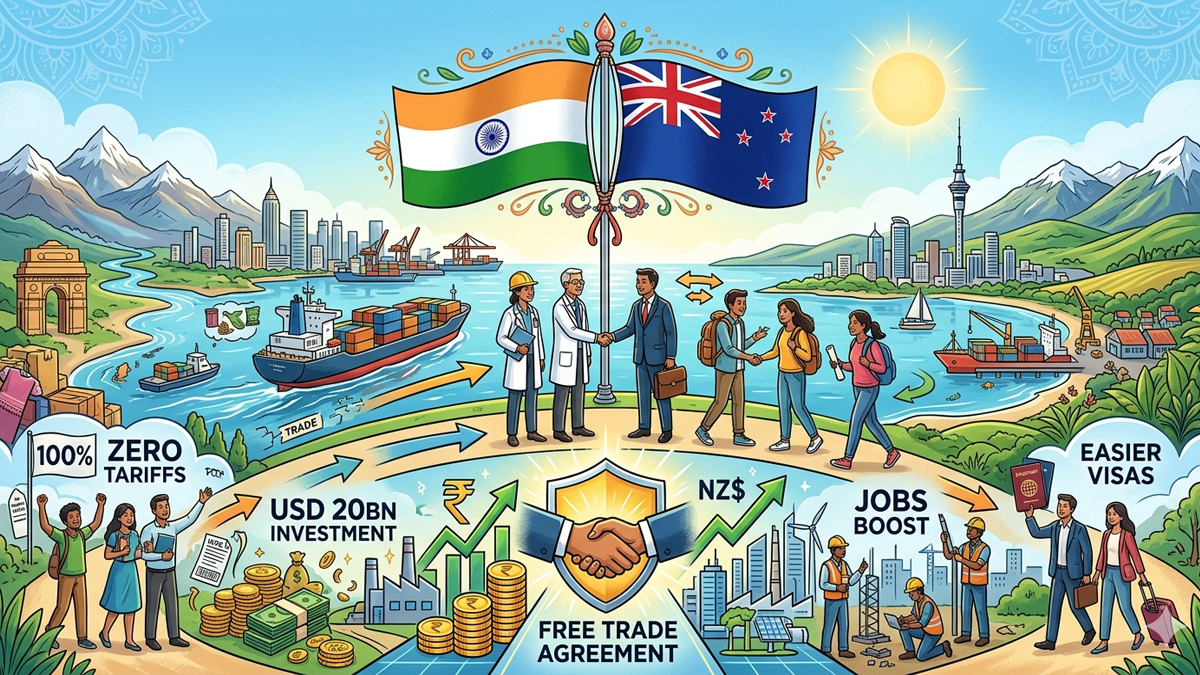
NEW DELHI: India and New Zealand have signed a sweeping Free Trade Agreement that removes tariffs on 100 per cent of Indian exports, marking one of the most ambitious trade deals in India’s recent economic playbook. The agreement also brings with it a USD 20 billion investment commitment and opens new doors for professionals, students and businesses on both sides.
The deal, concluded in just nine months after negotiations began in March 2025, is being billed as India’s fastest-ever FTA. It signals a clear intent to deepen economic ties with developed markets while positioning India as both a manufacturing hub and a supplier of skilled talent.
At its core, the agreement ensures duty-free access for all Indian goods entering New Zealand. This is expected to give a sharp competitive edge to sectors such as textiles, leather, engineering goods, footwear, gems and jewellery, and processed foods, many of which are labour-intensive and MSME-driven. For small businesses and women-led enterprises in particular, the zero-duty regime could translate into larger export volumes and new market footholds.
At the same time, India has taken a cautious stance in sensitive areas. Dairy, key agricultural products and select industrial goods remain shielded, ensuring domestic producers are not exposed to sudden competition. Nearly 30 per cent of tariff lines have been excluded, covering a significant portion of New Zealand’s exports to India.
Trade between the two countries has already been on an upward trajectory. Merchandise trade rose to USD 1.3 billion in 2024 to 2025 from USD 873 million the previous year, while services exports from India reached USD 634 million. The FTA is expected to accelerate this momentum, especially as it streamlines customs processes and reduces regulatory hurdles. Cargo clearance timelines, for instance, are set to improve to 24 to 48 hours, bringing predictability to exporters.
Beyond goods, the agreement ventures strongly into services and mobility. In a first, New Zealand has opened up its market to India’s traditional medicine systems, including Ayurveda and yoga, giving a formal push to the globalisation of AYUSH services. Indian professionals such as yoga instructors, chefs and music teachers are among those expected to benefit.
The pact also creates new pathways for Indian talent. A dedicated visa channel will allow up to 5,000 skilled professionals to work in New Zealand for up to three years. Students, particularly in STEM fields, will gain extended post-study work rights, while a working holiday visa programme will enable 1,000 young Indians each year to live and work in the country for up to 12 months.
Agriculture, often a sticking point in trade talks, has been handled with a mix of protection and partnership. While India has limited market access for sensitive imports like dairy, both sides have agreed to collaborate on improving productivity in areas such as apples, kiwifruit and honey. This includes research support, better planting materials and supply chain upgrades aimed at boosting farmer incomes.
Investment forms another key pillar of the agreement. New Zealand’s USD 20 billion commitment over the next 15 years is expected to flow into sectors such as renewable energy, digital services and infrastructure. A built-in rebalancing clause ensures accountability, allowing both sides to address any shortfall in investment delivery.
The agreement also strengthens regulatory frameworks. New Zealand has committed to enhancing protection for India’s geographical indications, while both countries will adopt stricter rules of origin to prevent misuse of tariff benefits. Simplified certification processes and digital trade facilitation measures are expected to lower compliance costs for exporters.
State-level gains are likely to be widespread. From textile hubs in Tamil Nadu and leather clusters in Uttar Pradesh to auto manufacturing in Haryana and pharmaceuticals in Maharashtra, the benefits cut across industries and regions. Coastal states stand to gain from increased marine exports, while agricultural regions could see higher realisation for processed and niche products.
Cultural cooperation is another notable feature. Engagement with Māori communities and a dedicated focus on traditional knowledge aim to deepen people-to-people ties, adding a soft power dimension to what is otherwise a hard-nosed trade agreement.
Taken together, the India–New Zealand FTA goes well beyond tariff cuts. It blends trade, talent and technology into a single framework, reflecting a broader shift in how India approaches global partnerships. If implemented effectively, the agreement could turn a relatively modest bilateral trade relationship into a dynamic economic corridor linking South Asia with the Pacific.