

MUMBAI: They took an insult and turned it into a movement.
Overnight.
Call them cockroaches.
Call them dimagi naxals.
They will wear the label, meme it into oblivion, and force resignations before the establishment finishes drafting its next clarification.
This is not protest as we knew it.
This is content-driven power.
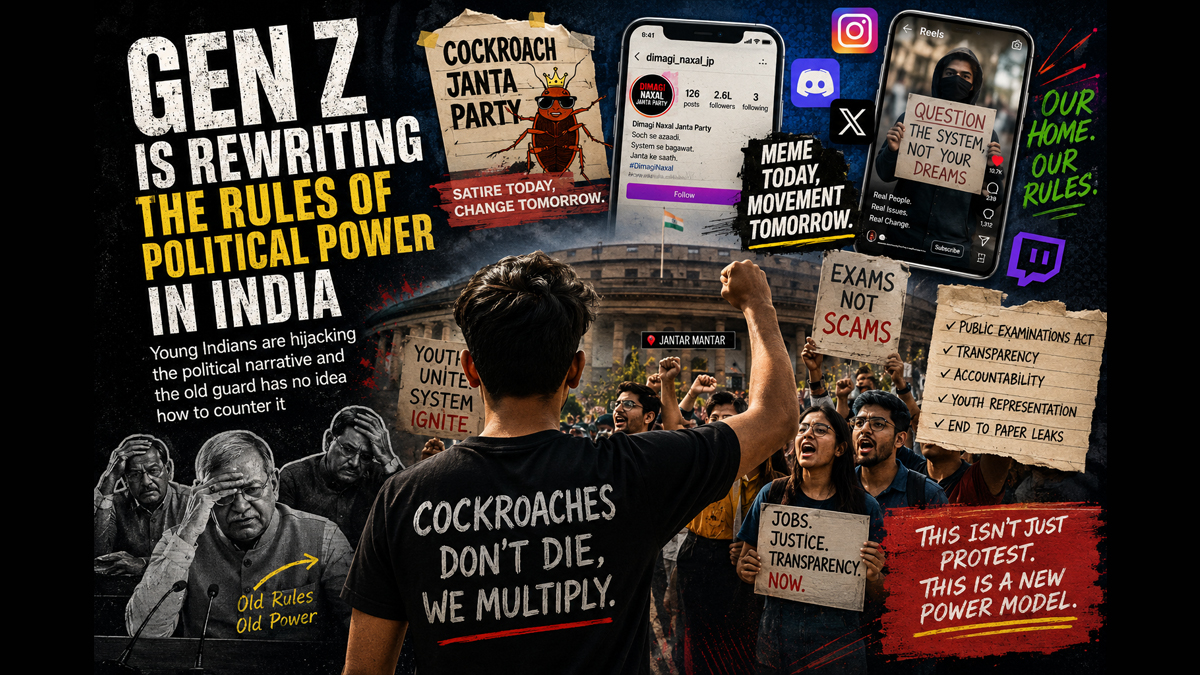
In May 2026 a Supreme Court chief justice’s alleged description of unemployed youth as “cockroaches” and “parasites” should have been a one-day controversy. Instead Abhijeet Dipke, a postgraduate student, launched the Cockroach Janta Party as pure satire. The handles gained millions of followers in days. By June and July the movement was occupying Jantar Mantar for 36 days over NEET paper leaks and systemic exam failures.
Police action, tear gas, the works.
Result: union education minister Dharmendra Pradhan resigned.
That is not noise.
That is leverage.
The same playbook moved to Jharkhand.
Local aspirants fighting recruitment fraud in the JSSC-CGL and JPSC exams found amplification from the cockroaches. After 24 days of protest and hunger strike led by Devendra Nath Mahto, chief minister Hemant Soren cancelled the exams, ordered a CID probe dating back to 2014, and set up a reforms panel.
The state BJP tried to claim ownership.
The students largely ignored the party flags.
Parallel power does not need traditional sponsors.
Then came Independence Day. Prime minister Narendra Modi’s warning about “dimagi naxals” — intellectual naxals in urban spaces — was meant to draw a line.
Gen Z treated it as product launch.
The Dimagi Naxal Janta Party appeared within hours.
An anonymous handle crossed 2.6 lakh Instagram followers in 24 hours.
When Instagram restricted the page, users simply shared direct links.
Opposition politicians rushed to claim the badge.
The government issued damage-control statements.
The meme had already travelled further and faster than any official communication.
This is the new media reality.
Traditional political messaging — speeches, press conferences, party machinery — is being outpaced by raw, decentralised, satirical content that lives on Discord, Instagram Reels, X and private servers.
Authenticity is the currency. Production values are irrelevant.
A joke becomes a street mobilisation in under a day.
Live streams from protest sites replace curated soundbites.
The old tools of narrative control look slow and clumsy by comparison.
Yet the impact runs far deeper than politics.
This cohort is rewriting culture itself. They have discarded the polished aesthetics of earlier generations for weaponised satire, absurdist irony and radical vulnerability. Memes are no longer just entertainment; they are the primary language of dissent and identity.
Slang functions as a cultural shield — “delulu is the solulu,” “brainrot,” “stand business” — signalling belonging while keeping outsiders at bay. De-influencing has become a mainstream stance: young creators actively tell audiences what not to buy, exposing greenwashing and corporate facades with the same ease they dismantle political ones.
They stay connected through tightly curated digital ecosystems that older institutions barely understand. Discord servers and private study rooms replace public timelines.
Twitch and Kick function as virtual third places where hours-long community hangouts build loyalty.
TikTok and Instagram Reels act as the cultural engine, accelerating trends, audio tracks and political calls to action at dizzying speed.
BeReal and similar platforms reward the unedited, mundane daily life over curated perfection.
Platform fluidity is the norm: a joke born in a niche Discord channel can migrate to Reels, then to the streets, within hours.
And they spread their arms wide with remarkable efficiency. What begins as a localised exam protest in Delhi is amplified nationally within days. Solidarity with Jharkhand aspirants follows the same digital pathways.
The cockroach and dimagi naxal identities travel across state lines through shared memes and reclaimed language.
Micro-communities on private servers coordinate logistics, share legal advice and sustain momentum long after the cameras leave.
The same networks that mock a judicial remark or a prime ministerial speech can, overnight, turn a single-issue grievance into a multi-state pressure campaign.
The political balance is shifting because the young no longer treat the system as inevitable.
Paper leaks, recruitment scams and institutional opacity have broken the traditional contract of “study hard, pass the exam, get the job.”
In its place sits a generation that builds its own amplification networks and extracts concrete outcomes — resignations, exam cancellations, reform committees.
The Cockroach Janta Party’s five demands, including a public examinations act and parliamentary oversight of exam bodies, read less like slogans and more like a legislative agenda forced from below.
Parties will keep trying to co-opt the energy.
Shadow bans and legal notices will keep arriving.
None of it changes the underlying dynamic. Gen Z has discovered that language, once weaponised against them, can be flipped into a high-velocity political and cultural instrument.
The cockroaches and the dimagi naxals are not going quiet.
They are rewriting the rules of engagement—and the culture that surrounds it—even as the traditional players are still looking for the remote.