

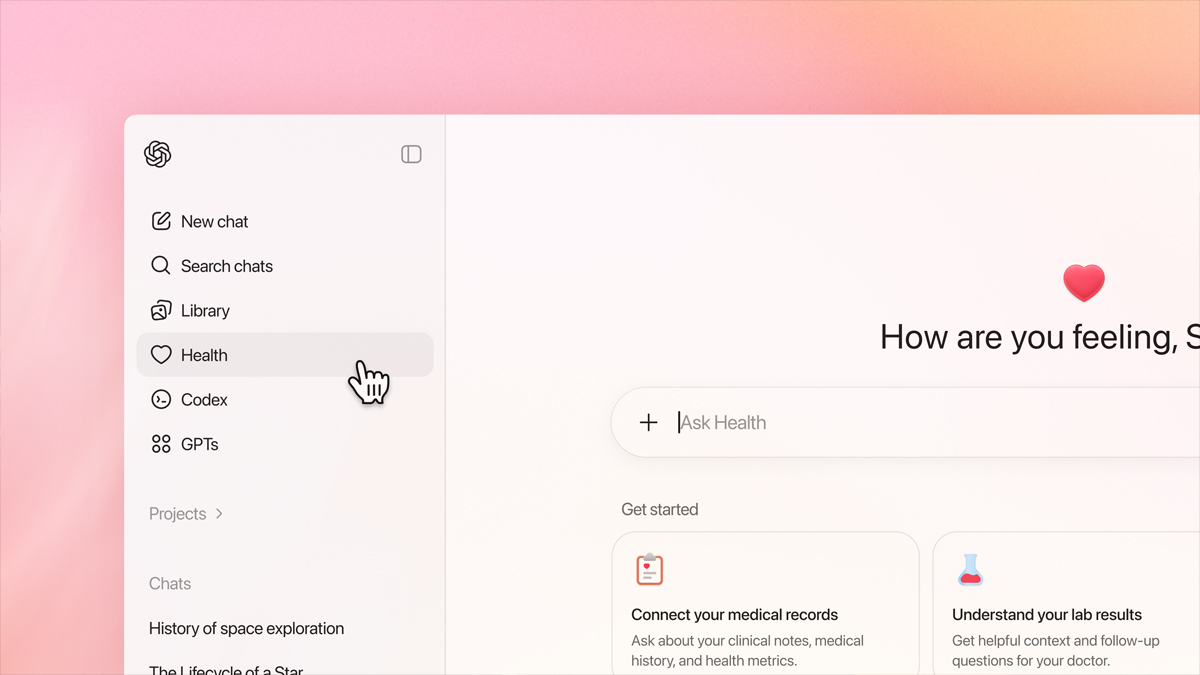
MUMBAI: Your next health check-up could begin with a chat but the diagnosis still belongs in the doctor’s office. OpenAI has introduced Health in ChatGPT, a new feature that allows eligible users in the United States to securely connect their Apple Health data and supported medical records, enabling the chatbot to provide more personalised responses based on an individual’s health history.
The launch marks a significant expansion of ChatGPT’s healthcare capabilities. Rather than relying solely on information entered during a conversation, the chatbot can with the user’s permission reference connected health records to answer questions with greater context.
The feature allows users to link data from Apple Health and compatible medical record providers, giving ChatGPT access to information such as medications, laboratory results, recent doctor visits, sleep patterns and activity data.
This means users can ask the chatbot to compare new blood test results with previous reports, summarise changes since a recent medical appointment, or explain how trends in sleep and physical activity fit into their overall health routine.
OpenAI said the feature is designed to help people better understand their medical information and prepare for discussions with healthcare professionals. It stressed that Health in ChatGPT is not intended to replace medical advice, diagnosis or treatment.
Users can enable the feature through the Health section in ChatGPT, where they choose whether to connect their medical information. Once permission is granted, ChatGPT can automatically reference relevant health data across conversations whenever it improves the quality of a response, removing the need to start every discussion inside a separate health workspace.
The Health section also functions as a central dashboard, allowing users to manage connected records, review synced information, monitor health trends and revisit previous health-related conversations.
The feature is rolling out to logged-in ChatGPT users aged 18 and above in the United States on the web and iOS. It is available across Free, Go, Plus and Pro plans, although OpenAI has not announced when it will expand to other countries. The feature is also not available in Codex.
OpenAI said the move reflects growing demand for AI-assisted health information, noting that more than 300 million people ask ChatGPT health-related questions every week. By connecting hospital records, wearable devices, laboratory reports and health apps, the company believes users can receive answers with richer context without repeatedly uploading the same information.
Privacy remains a central part of the rollout. OpenAI said users retain control over what health information they choose to connect and when ChatGPT can access it. The company also stated that connected Apple Health data, medical records and conversations based on them will not be used to train its foundation AI models or for targeted advertising.
The feature is powered by OpenAI’s latest AI models. According to the company, GPT-5.5 Instant expands advanced health reasoning capabilities to free users, while GPT-5.6 Sol is designed to better interpret complex medical information, ask for missing context and recommend professional medical care when appropriate.
With Health in ChatGPT, OpenAI is positioning its chatbot as a digital companion that helps users organise and understand their health information while keeping healthcare professionals firmly at the centre of diagnosis and treatment decisions.