

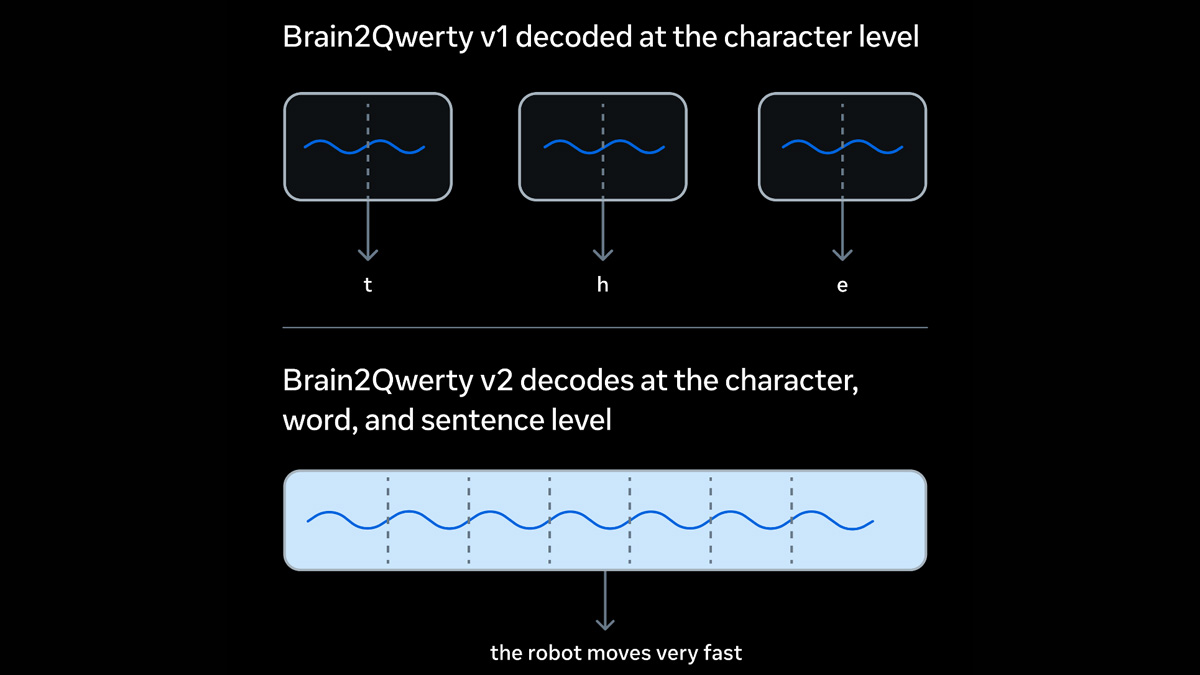
MUMBAI: Mind over keyboard may no longer be just a figure of speech. Meta has unveiled Brain2Qwerty v2, a new artificial intelligence system capable of translating brain activity into written sentences without requiring brain implants, marking a major leap in non-invasive brain-to-text technology.
Designed to support people who lose the ability to communicate following strokes, accidents or neurological disorders, the system uses magnetoencephalography (MEG) to capture brain signals from outside the head, eliminating the need for surgically implanted electrodes. Meta described Brain2Qwerty v2 as its most advanced end-to-end system for decoding complete sentences from non-invasive brain recordings in real time.
The model was trained using data from nine volunteers, each of whom spent around 10 hours inside an MEG scanner while typing nearly 22,000 sentences. Instead of relying on manually engineered neural signals, Brain2Qwerty v2 processes raw brain activity using end-to-end deep learning. Meta also fine-tuned large language models on neural data, enabling the system to use semantic context to better interpret noisy brain recordings.
According to the company, AI agents were employed to test multiple optimisation techniques for the decoding pipeline before engineers selected the final training configuration. The upgraded model has delivered a significant improvement in performance. Meta said Brain2Qwerty v2 achieved an average 61 per cent word accuracy, a substantial leap from the roughly 8 per cent reported by previous non-invasive brain decoding systems. For the best-performing participant, word accuracy reached 78 per cent, with more than half the decoded sentences containing one word error or fewer.
Researchers also found that accuracy improved as larger volumes of training data became available, suggesting the performance gap between non-invasive systems and implant-based brain-computer interfaces could narrow further over time.
Meta said invasive technologies such as stereotactic electroencephalography and electrocorticography have already demonstrated that AI-powered neuroprostheses can restore communication, but widespread adoption remains limited because they require brain surgery. Brain2Qwerty v2, the company believes, offers a more accessible alternative.
To encourage broader scientific collaboration, Meta is releasing the full training code for Brain2Qwerty v1 and v2, while its research partner, the Basque Center on Cognition, Brain, and Language (BCBL), will make the Brain2Qwerty v1 dataset publicly available. The company said the project forms part of its wider effort to develop open foundational brain models and accelerate research into diagnosing and treating neurological disorders.