
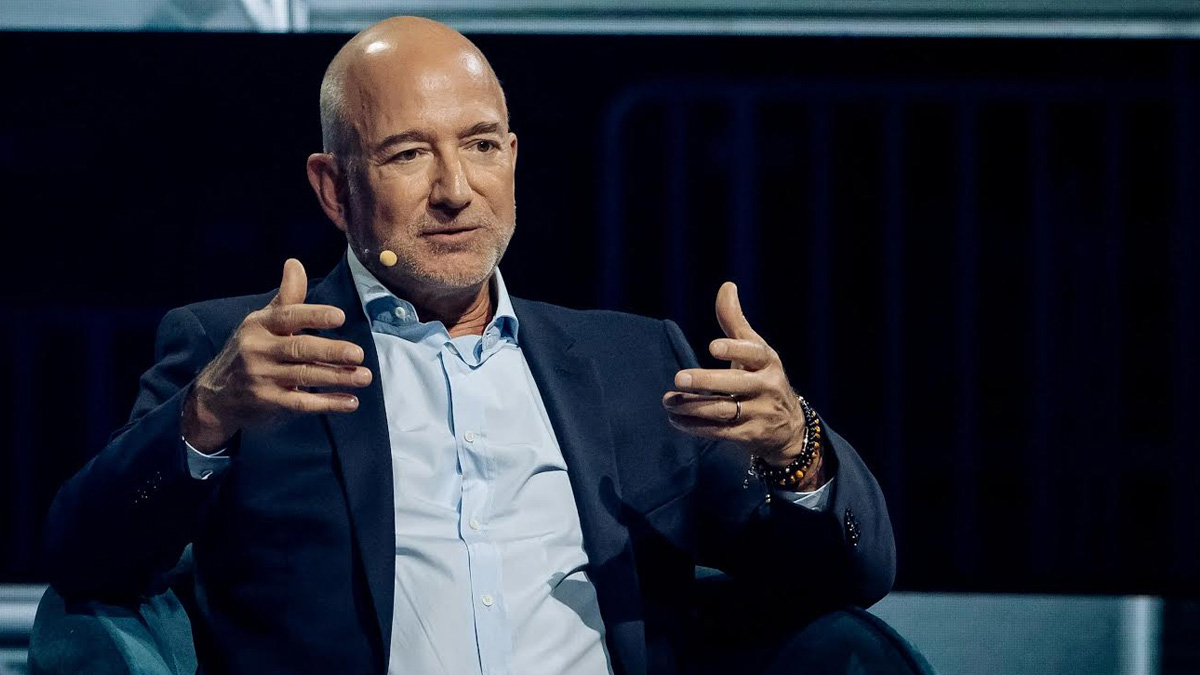
MUMBAI: The next big address might not be on Earth at all. Amazon founder Jeff Bezos expects millions of people to be living in space by 2045, with robots doing much of the heavy lifting on the Moon and beyond as advances in artificial intelligence (AI) and robotics make life beyond our planet increasingly conceivable.
Speaking at Italian Tech Week 2025, Bezos argued that technological progress over the next two decades could change the economics of space exploration. Rather than sending people into hazardous or physically demanding environments to perform routine work, he believes robots could take on many of those tasks more efficiently and economically.
The vision is not simply about building a workforce beyond Earth. Bezos suggested that future space residents would largely choose to live there, rather than being compelled to leave Earth for employment. In this scenario, machines would manage much of the operational work, while people could live in space because they wanted to, rather than because a job required them to.
That distinction could prove important as companies explore the possibility of sustained human activity beyond Earth. Sending astronauts into space involves considerable logistical and operational demands, particularly when missions require people to work in difficult environments. Robots capable of carrying out more of those tasks could reduce the need to expose humans to hazardous conditions and help make space operations more practical.
The Moon is one potential testing ground for this approach. Robotic systems could undertake physically demanding work on the lunar surface, supporting the infrastructure needed for more sustained human activity. Bezos did not suggest that robots would eliminate the need for people altogether; rather, his argument is that machines could handle much of the operational burden while humans take on other roles.
For Bezos, the case for AI extends beyond rockets and lunar bases. He also pushed back against pessimistic predictions about the technology, arguing that inventions have historically improved productivity and expanded prosperity by making goods and services more abundant.
To explain his optimism, he compared AI’s potential with the agricultural gains associated with the invention of the plough thousands of years ago. Just as improvements in farming helped people produce more with less effort, Bezos believes AI could enable society to accomplish far more than it can today.
His argument rests on the idea that technological progress tends to expand what is possible rather than simply replace existing activities. In the space industry, that could mean using AI and robotics to make exploration more efficient. Across the wider economy, it could mean greater productivity and more abundant resources, although the scale and distribution of those benefits remain uncertain.
Bezos expressed confidence that this pattern would continue, saying he saw little reason for people to be discouraged about the future given the possibilities emerging from technological advances. His outlook puts him among a growing group of technology leaders who believe space could become a destination for work and living, rather than remaining an environment visited mainly by astronauts on carefully planned missions.
OpenAI chief executive Sam Altman has also suggested that space could create new career opportunities for younger generations. He has predicted that college graduates could find entirely new roles in space within the next decade, potentially earning substantial pay as the industry develops.
Such a future would represent a significant shift in the idea of a career. Instead of choosing between familiar industries on Earth, future graduates could find opportunities in emerging space-related fields. However, these remain predictions, with the scale and timing of such employment dependent on technological development and the growth of the space economy.
Tesla chief executive Elon Musk has similarly championed expanding human access to space through SpaceX. His ambitions include establishing a human presence on Mars, with the company developing rockets and spacecraft intended to support future missions. While Bezos’s comments focus on millions of people living in space by 2045, Musk’s vision places particular emphasis on making humanity multiplanetary.
Dylan Taylor, founder and chief executive of Voyager Technologies, has offered an even earlier timeline for people living and working beyond Earth. In an interview with Fortune, Taylor predicted that this could begin in the early 2030s. He also envisaged a lunar base where people would live and work, potentially making human activity visible through lights on the Moon.
Voyager Technologies is developing a replacement for the International Space Station and holds multiple contracts with NASA, according to the report. Taylor’s forecast suggests that some industry figures expect the transition towards more sustained human activity in space to begin well before Bezos’s 2045 milestone.
The timelines, however, differ. Taylor anticipates people living and working beyond Earth as early as the early 2030s, while Bezos expects millions to be living in space by 2045. These predictions describe different stages of a possible transition, rather than a single agreed schedule for humanity’s expansion beyond Earth.
Not everyone among the world’s technology leaders is equally convinced that space should be the priority. Microsoft co-founder Bill Gates has argued that billionaires and world leaders have pressing challenges to address on Earth before directing too much attention towards distant destinations.
In an interview with comedian James Corden, Gates questioned the focus on space exploration, pointing to the considerable work that remains to be done on the planet. His position highlights a different set of priorities: improving life on Earth rather than concentrating resources on establishing a human presence elsewhere.
Gates’s views on AI also combine optimism with caution. While he has raised questions about whether the technology will ultimately benefit or harm humanity, he has suggested that automation could eventually reduce working hours substantially. He has predicted that machines might take over enough tasks to make a two-day working week possible, giving people more time to pursue interests outside their jobs.
The contrast is striking. Bezos sees AI and robotics helping make space more accessible, while Gates has highlighted the potential for automation to change life on Earth. Both visions involve machines taking over more tasks, but they place different emphasis on what humanity should do with the time and resources that technological progress could free up.
There are still substantial uncertainties around the idea of millions living in space. The technological, logistical and economic demands of sustaining large populations beyond Earth would need to be addressed, and the forecasts offered by technology leaders are not guarantees of what will happen. The role of robots in hazardous environments is one part of that wider challenge, rather than a complete solution.
For now, Bezos’s prediction offers a glimpse into a future in which space exploration could move beyond occasional missions towards more sustained human activity. If AI and robotics can make operations safer and more economical, the idea of living beyond Earth may become less remote even if the scale and timing remain open questions.
By 2045, the most significant change may not simply be how many people have left Earth, but how much of the work required to sustain them is carried out by machines. In Bezos’s vision, robots could handle the hard labour while humans make space their home. The final frontier, it seems, could one day come with an address, a job market and a very different idea of what it means to live and work.