
NEW DELHI: India’s search for buried mineral wealth is getting a digital upgrade. In a move that could reshape the country’s exploration landscape, the Geological Survey of India (GSI) is set to establish a Rs 100 crore Data Processing, Interpretation and Integration Centre (DPIIC) in Bengaluru, bringing artificial intelligence and machine learning into a sector that has traditionally relied on boots on the ground, rock samples and drilling rigs.
The proposed facility is expected to become the nerve centre of India’s effort to discover critical and strategic minerals, resources that are increasingly vital for electric vehicles, renewable energy systems, semiconductor manufacturing and defence production.
Over the next five years, the centre will analyse mineral-potential regions covering nearly 8.5 lakh square kilometres. Officials believe the project could significantly improve India’s ability to identify promising mineral deposits while reducing the time, cost and uncertainty associated with exploration.
For decades, mineral exploration in India has depended largely on geological mapping, field surveys and exploratory drilling. While those methods helped uncover many of the country’s major mineral belts, experts acknowledge that the next generation of discoveries is likely to be far more challenging. Increasingly, attention is shifting towards concealed and deep-seated deposits that leave few clues on the surface.
That challenge is precisely what the Bengaluru facility is designed to address.
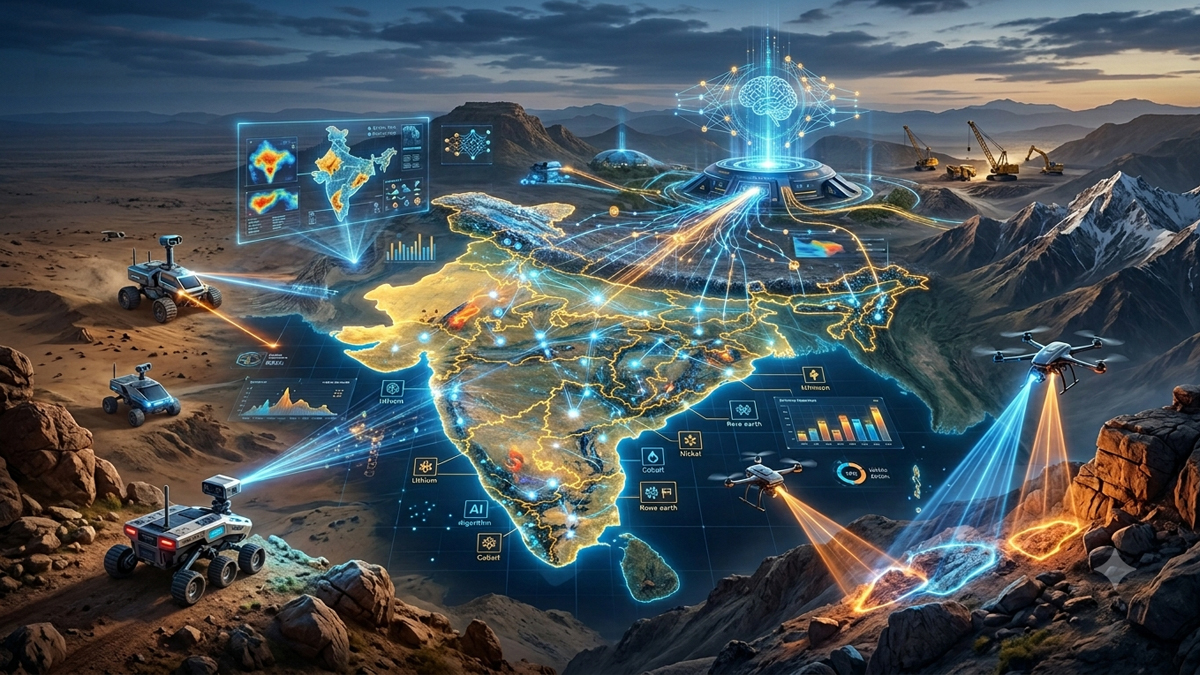
The DPIIC will integrate vast archives of geological, geophysical, geochemical and satellite data accumulated over several decades. Using artificial intelligence, machine learning algorithms and advanced analytics, scientists will be able to identify patterns that may indicate the presence of valuable mineral deposits hidden beneath the surface.
Rather than relying solely on conventional exploration techniques, researchers will generate predictive models and prospectivity maps that highlight areas with a higher probability of mineralisation. This could help narrow exploration targets before expensive field investigations and drilling programmes begin.
The objective is simple but ambitious: transform mountains of geoscientific data into actionable intelligence.
Officials believe the approach can improve exploration success rates, reduce risks and accelerate the progression of prospective areas towards detailed exploration and eventual mining.
The timing is particularly significant. As countries race to secure supplies of lithium, rare earth elements and other critical minerals, access to domestic resources is increasingly becoming a matter of economic and strategic importance.
India’s push towards electric mobility, renewable energy expansion, semiconductor production and defence self-reliance has intensified the need for a stable supply of critical raw materials. With global supply chains concentrated in a relatively small number of countries, policymakers are looking to strengthen domestic resource security.
Beyond mineral discovery, the Bengaluru centre is expected to serve as a national repository for geoscientific intelligence. Equipped with high-performance computing systems, cloud-based data infrastructure and advanced 3D visualisation tools, it will support researchers, exploration agencies and policymakers with detailed subsurface insights and data-driven decision-making.
Government officials expect the facility to help improve coordination across India’s exploration ecosystem while making more mineral-bearing areas ready for future development.
The Rs 100 crore investment also signals a broader transformation in how India approaches resource discovery. The country’s next major mineral finds may not begin with a geologist spotting clues in the field, but with an algorithm detecting patterns hidden deep within decades of geological data.
In other words, the future of mining may start long before the drill arrives, with artificial intelligence pointing the way underground.