

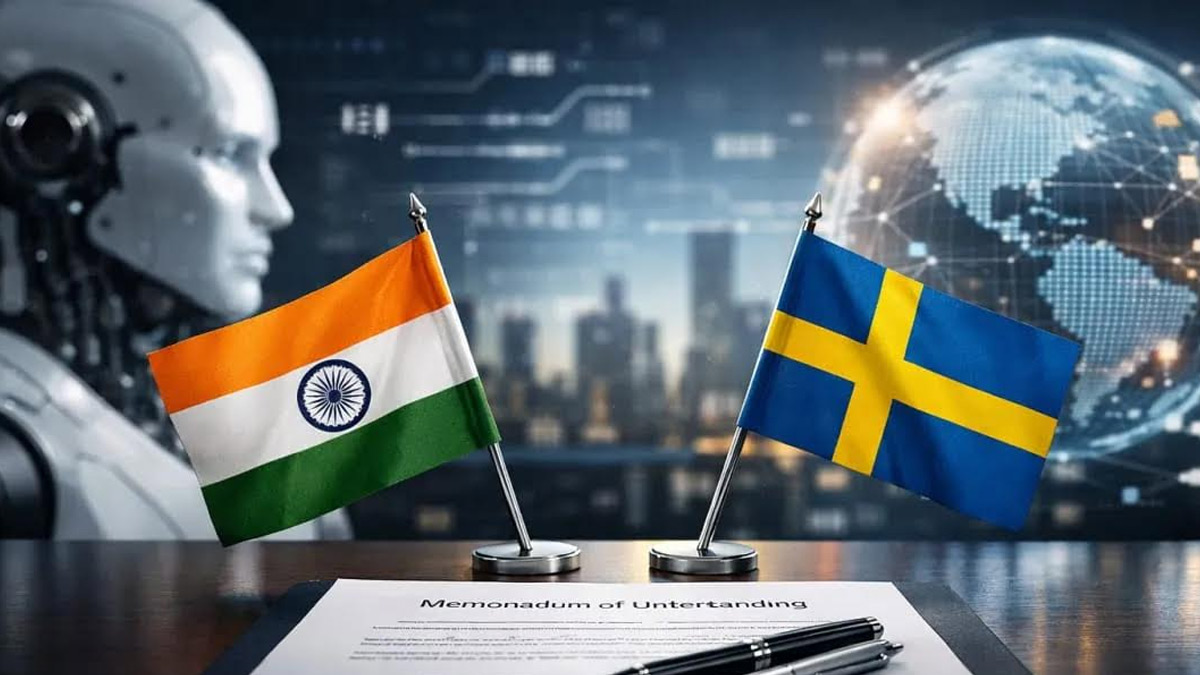
MUMBAI: When Swedish industrial muscle meets India’s digital scale, the AI equation could get a lot more interesting. India and Sweden are looking to turn that potential into practical partnerships, with senior officials and companies from both countries discussing deeper cooperation in artificial intelligence and digitalisation under the Sweden-India Technology and AI Corridor (SITAC).
The bilateral dialogue, organised by the IndiaAI Mission under the Ministry of Electronics and Information Technology (MeitY), was held at Electronics Niketan in New Delhi. It brought together government representatives, Swedish businesses and Indian technology companies to explore opportunities across India’s expanding AI ecosystem.
The talks focused on India’s AI growth story and the opportunities it could create for Swedish companies, particularly as the country builds out its AI infrastructure, innovation ecosystem and pathways for responsible technology adoption.
IndiaAI Mission CEO Saurabh Vijay highlighted the complementary strengths of the two countries, with Sweden bringing industrial, research and advanced manufacturing expertise, while India offers scale, digital public infrastructure, a large pool of AI talent and testing environments.
The IndiaAI Mission outlined its key priorities, spanning compute capacity, datasets and models, indigenous and domain-specific AI, application development, future skills, start-up financing and Safe & Trusted AI.
But the conversation was not just about building smarter systems. Participants also examined the nuts and bolts of getting enterprise AI adopted at scale, including data governance, localisation, responsible AI, infrastructure and market access.
The Swedish delegation was led by Johnny Eriksson, Market Manager at Business Sweden, who presented an overview of SITAC and Sweden’s priorities in AI and digitalisation. Agnes Julin, Minister Counsellor and Deputy Head of Mission at the Embassy of Sweden in India, also addressed the gathering.
Julin said the two countries want to maintain an open environment for business opportunities in AI and electronics, while strengthening links between trade, regulation and innovative start-ups.
The corporate presence added a strong industrial dimension to the discussions. Swedish participants included Autoliv, Consat, IKEA, Saab, Sandvik AI, Sandvik Intelligent Manufacturing, SKF and Volvo Group.
They were joined by Indian technology and AI companies including Tech Mahindra, Tata Consultancy Services (TCS), Zenteiq, Avataar AI, Innefu, CoRover.ai, Gnani and Globals ITES.
The companies explored potential areas where Swedish industrial expertise could align with India’s AI priorities, including industrial AI, trusted data, computing capacity, skills and responsible AI.
Importantly, the discussions looked beyond broad statements of intent. Participants considered potential pilots, testbeds, co-development projects and commercial partnerships, with an emphasis on matching technology solutions to specific enterprise and industrial requirements.
For the Swedish delegation, the engagement offered a window into India’s enterprise AI capabilities and deployment-ready innovations. For Indian companies, it opened the door to potential partnerships with Swedish industrial and technology players.
The SITAC engagement is expected to support further cooperation through pilots, testbeds and ecosystem partnerships in AI and digitalisation.
With Sweden bringing industrial depth and India bringing scale, talent and digital infrastructure to the table, both sides appear keen to turn their AI compatibility into something more tangible — moving the conversation from what the technology could do to what the two countries can actually build together.