
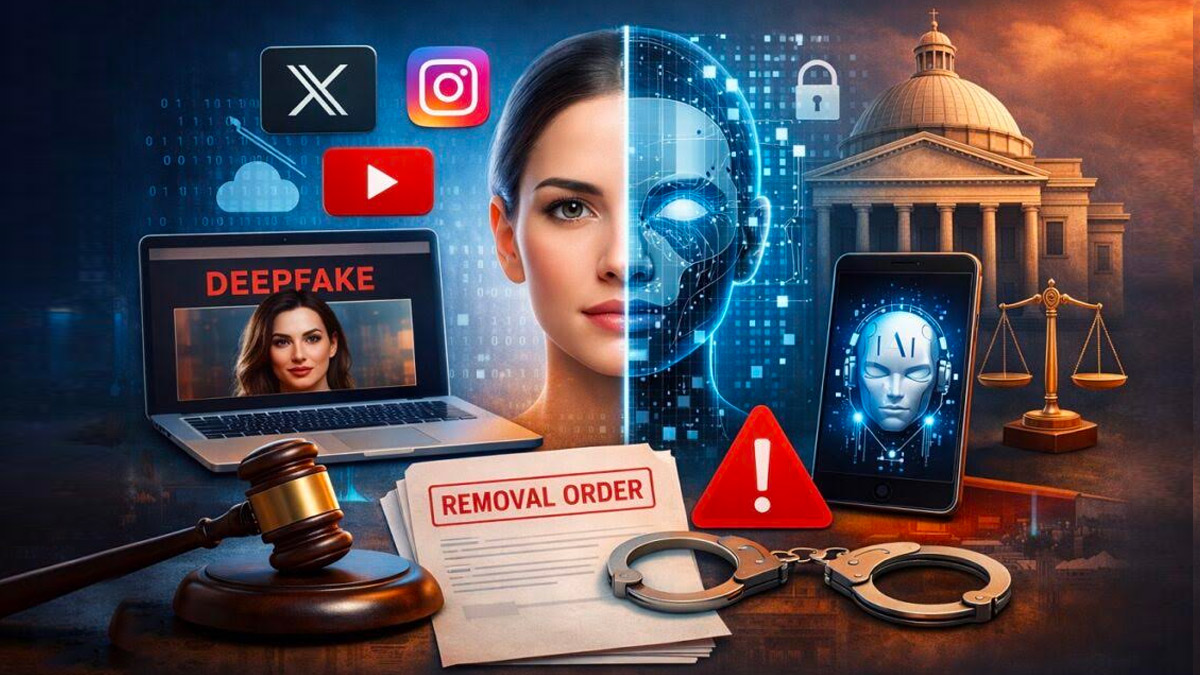
MUMBAI: Deepfakes may be getting smarter, but the Government wants the rulebook to move even faster. India has unveiled a tougher regulatory framework to curb the misuse of AI-generated content, imposing stricter obligations on online platforms, sharply reducing content removal timelines and backing new AI-powered detection technologies under the IndiaAI Mission.
The updated framework, announced by the Ministry of Electronics and Information Technology (MeitY), aims to tackle the growing misuse of AI-generated audio, video and text while strengthening accountability across digital platforms.
As part of the initiative, the government has approved 13 Responsible AI projects focused on deepfake detection and trustworthy AI systems at educational institutions across the country.
One of the biggest changes is a dramatic reduction in compliance timelines. Under amendments introduced on 10 February 2026, platforms must now remove unlawful content within three hours of receiving valid government or court directions, replacing the earlier 36-hour deadline.
Grievance redressal timelines have also been shortened from 72 hours to 36 hours, while complaints involving sensitive content such as nudity and impersonation must now be addressed within two hours, down from the previous 24-hour window.
The revised rules also require legally permissible AI-generated content to carry clear labels and traceable metadata, making it easier for users to identify synthetic material. Platforms must deploy reasonable technical measures, including automated tools where appropriate, to prevent the creation and circulation of unlawful AI-generated content.
The regulations explicitly cover harmful AI-generated material, including child sexual exploitation content, non-consensual intimate imagery, impersonation and other illegal synthetic media.
The government said Significant Social Media Intermediaries (SSMIs) platforms with more than 50 lakh registered users in India—will continue to face additional compliance obligations. These include deploying automated tools to detect unlawful content, publishing compliance reports, appointing India-based compliance officers and grievance officers, assisting law enforcement where required and providing user verification and appeal mechanisms.
Platforms that fail to comply risk losing the safe harbour protection available under Section 79 of the Information Technology Act, 2000, exposing them to potential legal action.
The new framework builds on existing provisions under the Information Technology Act, 2000, the Bharatiya Nyaya Sanhita, 2023, and the Information Technology (Intermediary Guidelines and Digital Media Ethics Code) Rules, 2021, which already prohibit content involving impersonation, privacy violations, obscenity, child abuse and threats to public order or national security.
Alongside regulation, the government is expanding AI research through the IndiaAI Mission. Among the approved projects are Saakshya, a multi-agent deepfake detection framework developed by IIT Jodhpur and IIT Madras, AI Vishleshak for improving audio-visual forgery detection, and an IIT Kharagpur project focused on real-time voice deepfake detection.
The government is also using AI beyond online safety. It highlighted the Gyan Bharatam platform, which employs technologies including Optical Character Recognition (OCR), Handwritten Text Recognition (HTR), semantic search and machine-assisted translation to digitise and preserve India’s manuscript heritage. The platform also includes Gyan Mitram, an AI-powered knowledge interface, and BharatiyaGPT, which converts manuscripts into multilingual conversational AI experiences.
Public awareness efforts have also been scaled up. According to the government, the Information Security Education and Awareness (ISEA) programme has conducted 6,650 cybersecurity awareness workshops, reaching more than 11.37 lakh participants, including students, teachers, law enforcement personnel and government officials. Meanwhile, CERT-In continues to issue advisories on AI-related cyber threats, including a dedicated deepfake advisory released in November 2024.
The details were shared by Union Minister of State for Electronics and Information Technology Jitin Prasada in a written reply in the Lok Sabha on 29 July 2026.
The latest measures signal India’s shift from merely responding to AI-driven harms to proactively regulating them. As deepfakes become more sophisticated and widespread, the government is combining faster enforcement, stricter platform accountability and home-grown AI innovation in an effort to stay ahead of a technology that is evolving at breakneck speed.