

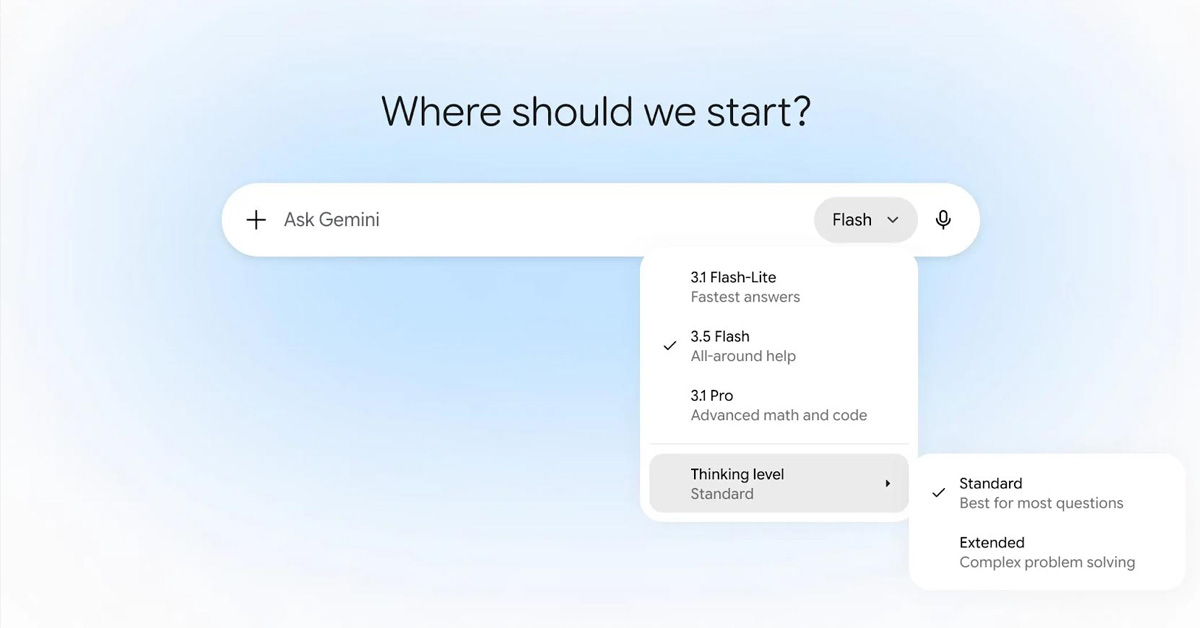
MUMBAI: Google’s AI race is shifting into a higher gear, but its flagship contender is still waiting in the pit lane. Google DeepMind has expanded its Gemini family with the launch of Gemini 3.6 Flash, Gemini 3.5 Flash-Lite and Gemini 3.5 Flash Cyber, sharpening its focus on affordability, speed and cybersecurity, even as the much-anticipated Gemini 3.5 Pro remains under wraps.
Leading the new lineup is Gemini 3.6 Flash, which replaces Gemini 3.5 Flash as Google’s primary lightweight model for production workloads. The company said the model delivers stronger performance across coding, knowledge work and multimodal tasks while using up to 17 per cent fewer output tokens, helping lower computing costs.
Google added that the model also requires fewer reasoning steps and tool calls, reducing the overall cost of running AI agents and enterprise workflows.
Alongside it, the company unveiled Gemini 3.5 Flash-Lite, positioning it as its most economical model for high-volume AI applications where speed, efficiency and lower operating costs take priority over advanced reasoning.
The third addition, Gemini 3.5 Flash Cyber, is a specialised cybersecurity model built on Gemini 3.5 Flash and fine-tuned to identify, validate and fix software vulnerabilities across large codebases. According to Google, the model enables security agents to analyse more code paths while keeping infrastructure costs under control.
Given its security-focused capabilities, Gemini 3.5 Flash Cyber will initially be available only through a limited-access pilot for governments and trusted partners via Google’s CodeMender platform, with broader availability planned at a later stage.
Google said the cybersecurity model has already outperformed its standard Flash counterparts in internal security evaluations. The company added that it has been used to detect and remediate vulnerabilities across products including Chrome, Android, Cloud, Ads and YouTube.
In one example, Google’s Cloud Vulnerability Research team used the model to identify remote code execution vulnerabilities and a memory corruption flaw in just two hours, demonstrating its potential to accelerate software security workflows.
However, the biggest talking point was arguably what Google did not announce. The company stopped short of releasing Gemini 3.5 Pro, its flagship model for advanced reasoning and coding, despite previously indicating it would follow the Flash releases unveiled in May.
The delay comes as rival AI developers continue to roll out increasingly capable frontier models, intensifying competition in the race to build the next generation of artificial intelligence systems.
Addressing the timeline, Google DeepMind Product Lead Logan Kilpatrick said the company is currently testing Gemini 3.5 Pro with selected partners and hopes to launch it soon. He also revealed that DeepMind has begun its most ambitious pre-training run yet for Gemini 4, signalling that Google’s next wave of AI development is already underway even as its current flagship remains in the wings.