

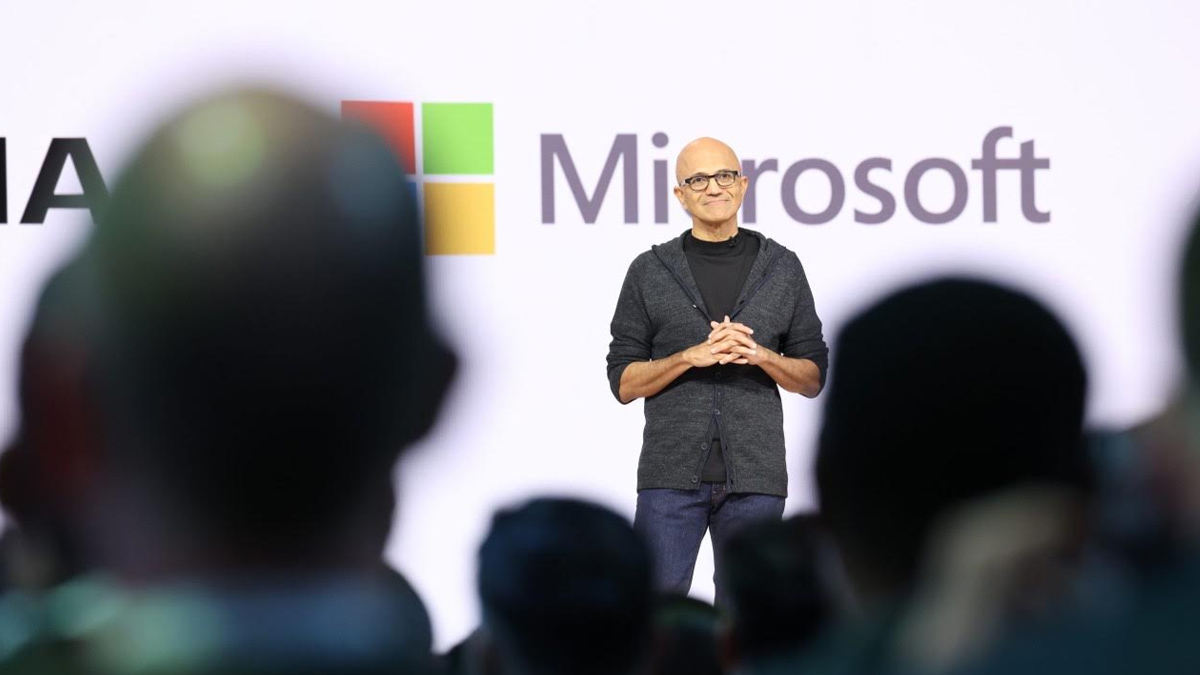
MUMBAI: Looks like Microsoft is no longer selling software, it wants to sell the brain behind tomorrow’s businesses. The company’s latest earnings call may have celebrated record financial performance, but the bigger message was strategic: Microsoft is positioning itself as the operating system for the artificial intelligence economy, where enterprise knowledge, rather than AI models alone, becomes the most valuable asset.
Microsoft closed FY26 with annual revenue of $331 billion, while Microsoft Cloud crossed $214 billion in annual revenue. Azure also reached a significant milestone, surpassing $100 billion in annual revenue for the first time.
Yet Chief Executive Satya Nadella spent far less time discussing financial results than explaining why every organisation will need what he called its own “learning machine,” an AI system built around its proprietary data, institutional memory and business context.
“At the end of the day, if a firm is a learning machine, they need their own learning machine,” Nadella told analysts, arguing that AI models will increasingly become interchangeable while enterprise data will emerge as the real competitive advantage.
That philosophy is reshaping Microsoft’s product strategy. Copilot, originally introduced as an AI assistant inside Microsoft 365, is evolving into what Nadella described as a “super app” capable of combining chat, software development, autonomous AI agents and collaborative workflows across both consumer and enterprise environments.
The strategy appears to be resonating with customers. Microsoft now has more than 30 million paid Microsoft 365 Copilot seats, with net additions more than doubling quarter on quarter. Nadella also revealed that user engagement levels are approaching those of established products such as Outlook and Teams, while enterprise adoption timelines have shortened dramatically from months to days.
The company also signalled a fundamental shift in how enterprise software will be priced. Instead of relying solely on traditional software licences, Microsoft is embracing what executives described as a “seat plus consumption” model, where customers pay both for user subscriptions and the amount of AI computing they consume.
Behind that vision sits an enormous infrastructure investment. Despite ongoing concerns over an AI spending bubble, Microsoft said Azure revenue grew 43 per cent during the quarter, while demand for computing power continues to outstrip available capacity.
To keep pace, the company added 31 new data centres across five continents during the quarter, bringing the annual total to 88. Microsoft also added another gigawatt of AI computing capacity and expects to spend $175 billion on capital expenditure during calendar year 2026, underscoring the scale of its AI ambitions.
Nadella also made clear that Microsoft does not believe enterprises should rely on a single AI model. The company’s ecosystem now supports more than 11,000 AI models, including offerings from OpenAI, Anthropic, xAI, Mistral and Microsoft’s own MAI family. Since the beginning of the year, the number of customers using multiple AI models has increased five-fold, reflecting growing demand for flexibility and resilience.
Away from Copilot, GitHub is emerging as another pillar of Microsoft’s AI strategy. The platform now has 225 million developers, while GitHub Copilot has grown to 50 million users. Nadella said one in every three pull requests on GitHub now involves an AI agent, highlighting how software development is rapidly becoming one of the first professions to embrace autonomous AI systems.
Cybersecurity is following a similar path. Microsoft recently introduced Project Perception, an AI-driven security platform that deploys specialised agents to simulate attacks, identify vulnerabilities and recommend fixes, reinforcing the company’s ambition to embed AI across critical enterprise functions.
Even Microsoft’s advertising business continued to expand amid the AI push. Search advertising revenue, excluding traffic acquisition costs, grew 10 per cent, supported by stronger revenue per search across Bing and Edge. Nadella also noted that Bing and Edge have gained market share for five consecutive years, while LinkedIn recorded double-digit member growth for a fifth straight year.
Taken together, the results suggest Microsoft’s biggest AI bet extends well beyond chatbots or large language models. The company is positioning itself as the infrastructure layer for enterprise intelligence, one where data, software, cloud computing and autonomous AI agents work together to help organisations continuously learn, adapt and compete.
If the latest earnings call offered one clear takeaway, it was this: Microsoft believes the future of AI will not be won by the smartest chatbot, but by the platform that helps businesses think for themselves.