
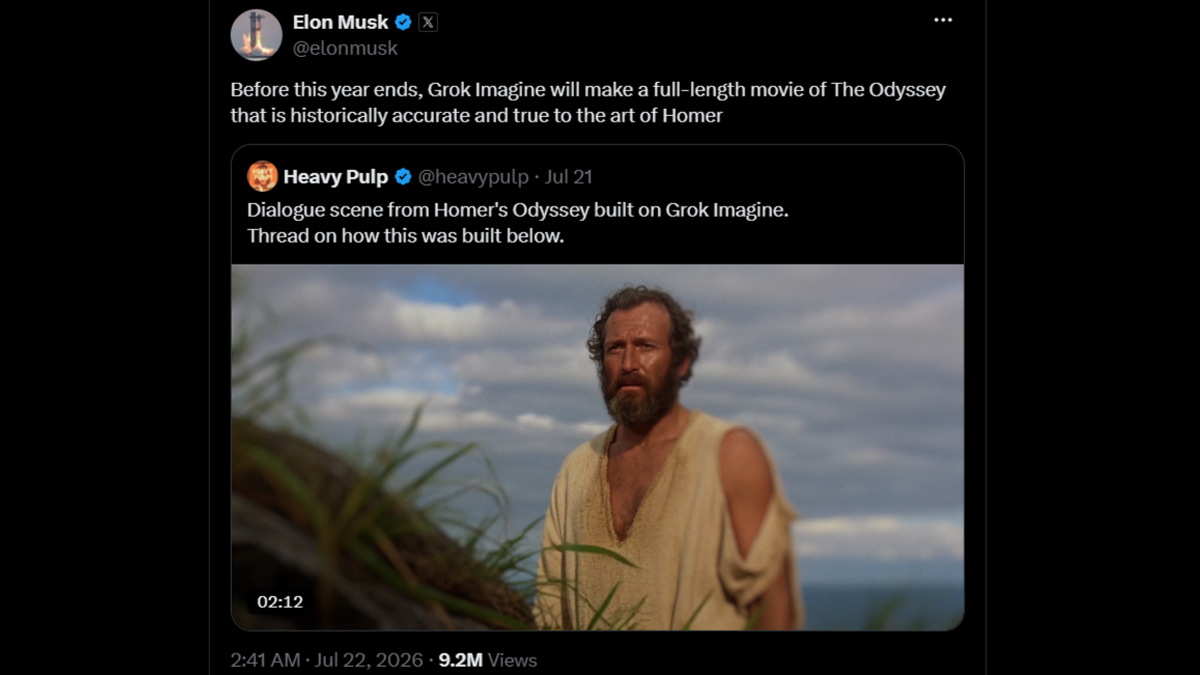
MUMBAI: Elon Musk wants AI to set sail where Hollywood already has. The billionaire has claimed that xAI’s Grok Imagine will produce a full-length adaptation of The Odyssey before the end of the year, setting the stage for a fresh debate over the future of AI-generated filmmaking.
The announcement came after AI content creator Heavy Pulp shared a three-minute proof-of-concept video depicting a dialogue scene between Odysseus and the nymph Calypso from Homer’s The Odyssey. The sequence was created using Grok Imagine, xAI’s flagship AI video generation tool powered by its Aurora model, alongside prompt engineering and manual editing.
Before this year ends, Grok Imagine will make a full-length movie of The Odyssey that is historically accurate and true to the art of Homer https://t.co/bVHzUmY9WN
— Elon Musk (@elonmusk) July 22, 2026
Quote-posting the video on X, Musk wrote: “Before this year ends, Grok Imagine will make a full-length movie of The Odyssey that is historically accurate and true to the art of Homer.”
The post is widely seen as the latest chapter in Musk’s criticism of Christopher Nolan’s big-budget adaptation of The Odyssey. Nolan’s reported $250 million production, starring Matt Damon and Anne Hathaway, has enjoyed a strong box office debut and positive reviews. Musk, however, has repeatedly criticised the film’s modernised dialogue and diverse casting choices, particularly Lupita Nyong’o’s portrayal of Helen of Troy, describing them as an example of Hollywood’s “DEI” approach.
By positioning Grok Imagine as an alternative, Musk argued that AI could recreate Homer’s epic without what he views as unnecessary modern reinterpretations.
The demonstration shared by Heavy Pulp highlights both the promise and the current limitations of AI filmmaking. Rather than generating a continuous film, the creator produced dozens of individual clips, each lasting up to around 15 seconds, before stitching them together into a coherent three-minute sequence through manual editing.
The video drew attention for its cinematic visuals, including detailed bronze armour, realistic lighting, convincing environmental effects and synchronised lip movements. While many viewers praised the quality of the imagery, the workflow remains labour intensive and far removed from the process required to produce a feature-length film.
Industry observers remain sceptical about Musk’s timeline. Current AI video models continue to struggle with long-form storytelling, maintaining consistent character appearances across scenes, preserving wardrobe and lighting continuity, and automating narrative pacing over a 90 to 120-minute runtime.
The claim of creating a “historically accurate” version of The Odyssey also sparked humour online, with commentators pointing out that Homer’s tale features mythical beings including the Cyclops, sea monsters and interventions from Greek gods, making historical accuracy a complicated proposition.
Even so, Musk’s comments underscore the rapid pace of AI video development and his ambition to challenge traditional filmmaking. Whether Grok Imagine can deliver a feature-length adaptation this year remains uncertain, but the conversation has already shifted from whether AI can generate cinematic scenes to whether it can sustain an entire narrative.