
MUMBAI: India is producing garbage faster than it is building systems to manage it and that gap may become one of the country’s biggest economic turning points this decade.
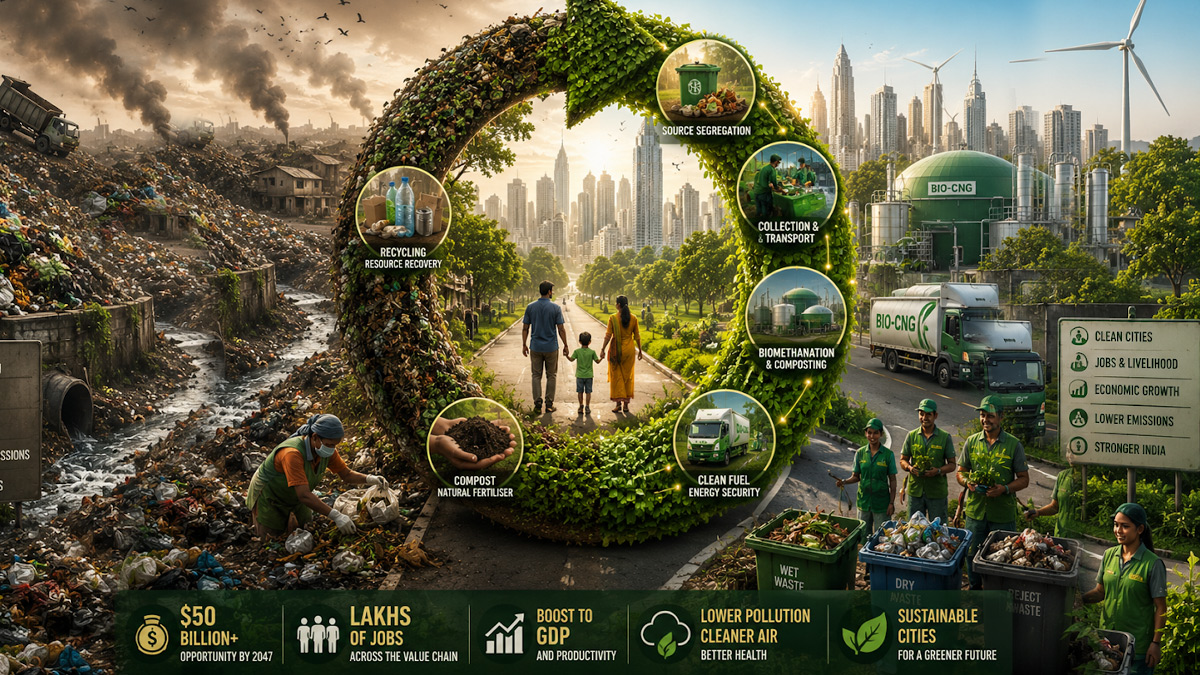
What currently sits in overflowing landfills, clogged drains and smoky dump yards could soon power a multi-billion-dollar industry spanning clean energy, logistics, fertilisers, recycling and urban infrastructure. According to a new study by the Council on Energy, Environment and Water (CEEW), India’s urban organic waste sector alone could unlock an opportunity worth more than $50 billion by 2047.
But the real story lies in what happens before that.
By 2030, India’s waste economy could begin reshaping urban growth, creating lakhs of jobs, reducing pollution, strengthening energy security and improving city productivity if policymakers and municipalities fix the structural problems holding the sector back.
Right now, India generates nearly 1.71 lakh tonnes of municipal solid waste every day, nearly half of it organic waste such as food scraps, vegetable waste, flowers and horticulture residue. Yet much of this waste still ends up mixed together and dumped into landfills because segregation at source remains poor across most cities.
That single weakness continues to cripple the entire waste value chain.
When wet and dry waste are not separated properly at homes, restaurants and markets, composting becomes inefficient, recyclables lose value and biomethanation plants struggle to operate effectively. Municipalities end up spending heavily on transporting mixed waste instead of recovering value from it.
In simple terms, India is throwing away a potential fuel and fertiliser economy every single day.
The environmental cost is equally severe.
Open waste burning contributes significantly to PM2.5 pollution levels in Indian cities, while unmanaged organic waste releases methane, one of the most potent greenhouse gases. As urban populations rise, these pressures are expected to intensify sharply over the next decade.
This is why waste management is no longer merely a sanitation challenge. It is rapidly becoming an economic and sustainability issue tied directly to India’s future urban growth.
Globally, waste is increasingly being treated as an economic resource rather than a disposal problem. Countries are investing heavily in circular economies where waste gets converted into fuel, fertilisers and industrial inputs. India has started moving in that direction through programmes such as GOBARdhan, SATAT and the updated solid waste management rules, which now mandate segregation and local processing of wet waste.
But execution remains weak.
Most Indian cities still lack reliable waste data, decentralised processing infrastructure and strong enforcement systems. Contractors are often paid based on the quantity of waste collected rather than the quality of segregation or recovery. Compost markets remain underdeveloped, while bio-CNG infrastructure is still limited despite rising policy support.
That disconnect between policy ambition and on-ground implementation is where India risks losing the opportunity.
Because the potential upside is enormous.
Organic waste can be converted into compost, biogas and biomethane, which can then be purified into bio-CNG, a cleaner transport fuel capable of reducing dependence on fossil fuels. A large-scale shift towards biomethanation could also strengthen India’s energy security while cutting landfill emissions.
The sector could emerge as a major employment engine too.
Unlike many capital-intensive industries, waste management creates jobs across both skilled and informal sectors. Collection workers, plant operators, chemists, technicians, logistics managers and maintenance staff would all form part of a growing green workforce.
According to the CEEW study, direct employment in the sector could rise dramatically over the coming decades, creating lakhs of new jobs linked to collection, processing, transport, fuel generation and fertiliser distribution.
The economic ripple effects could stretch much further.
Cleaner cities reduce healthcare burdens, improve productivity and lower municipal costs tied to landfill management and pollution control. Expanding waste-to-energy infrastructure could also attract private investment, improve local manufacturing ecosystems and open new carbon-credit opportunities.
In macroeconomic terms, the waste economy touches everything from energy imports and urban productivity to climate targets and GDP growth.
But none of it works without fixing the basics first.
India’s waste economy still begins at the household level. Without consistent source segregation by citizens, even the best processing infrastructure will fail. Cities will also need stronger accountability systems, performance-linked contracts, decentralised waste facilities and financing models that reward recovery rather than disposal.
Cities already showing what works
Indore: Turning wet waste into fuel and revenue
Indore has emerged as India’s most successful waste-management model by enforcing strict source segregation and near-complete door-to-door collection. The city converts wet waste into bio-CNG and compost, creating both environmental and economic value. Indore also undertook large-scale bio-mining of old landfill sites, reducing methane emissions while reclaiming urban land.
Ambikapur: Decentralised waste systems powered by women
The Chhattisgarh town of Ambikapur built a decentralised waste-management network run largely by women’s self-help groups. Segregation centres process different categories of waste locally, while organic waste is composted instead of dumped into landfills. The city became a model for smaller urban centres looking to build low-cost circular waste economies.
Kerala: Hyperlocal composting and community biogas
After repeated landfill crises, Kerala shifted towards decentralised waste processing through household composting units, ward-level treatment centres and community biogas plants. Cities such as Alappuzha and Thiruvananthapuram reduced dependence on giant dumping grounds by processing waste closer to where it is generated.
Surat: Waste reform as urban infrastructure
Surat transformed its sanitation and waste systems after severe public-health crises in the 1990s. Investments in scientific waste management, monitoring systems and cleaner urban infrastructure improved public hygiene, city productivity and investor confidence. Surat’s experience showed how waste reform directly impacts economic growth and quality of life.
These cities prove that India’s waste economy is no longer a distant sustainability dream. The challenge now lies in scaling these successes nationally.
The next five years may determine whether India continues burying its waste problem underground or turns it into one of the country’s largest green growth industries.
Because the future of India’s cities may ultimately depend on what happens to the waste they throw away.