
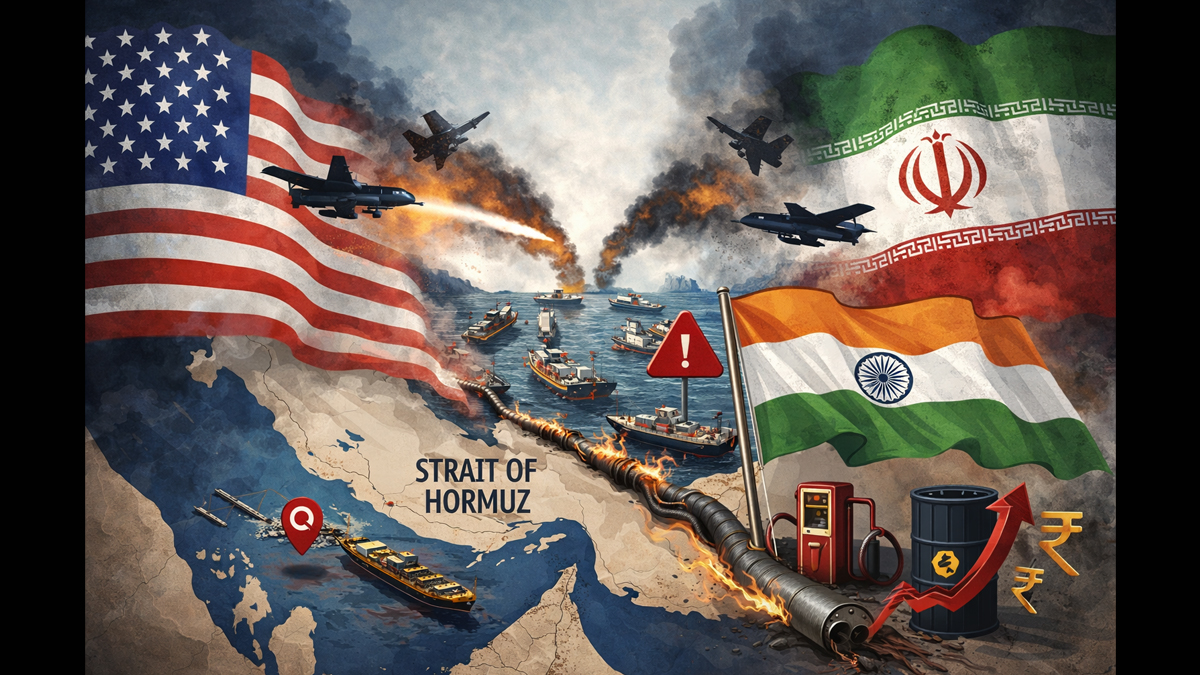
MUMBAI: The Middle East has blown up global markets and India is squarely in the blast radius. American and Israeli strikes on Iran have triggered the sharpest deterioration in global risk sentiment in years, sending Brent crude surging nearly 20 per cent in a single week to breach $100 a barrel, its highest level since July 2022. Iran, for its part, has threatened attacks on regional energy infrastructure and warned that oil could rocket toward $200 a barrel if the conflict deepens. Nobody is calling that a ceiling anymore.
The chokepoint that matters
At the heart of the crisis sits the Strait of Hormuz, a 33km waterway through which roughly 25 per cent of all global seaborne oil trade passes. Supplies from Saudi Arabia, the UAE, Iraq, Qatar, Bahrain and Oman all flow through it. As of mid-March, traffic through the strait had virtually seized up. Marine traffic data shows ships holding back, ocean carriers waiting to see how the stand-off between Washington, Tel Aviv and Tehran unfolds. Iraq, the UAE and Kuwait have cut production. The combination of supply cuts and a paralysed chokepoint has intensified global supply concerns to a degree not seen since the Russia-Ukraine war.
India’s exposure is acute
India imports nearly 89 per cent of its crude oil and 81 per cent of its total oil and gas needs, making it one of the world’s most vulnerable large economies to an oil shock. The country’s crude import bill ran to $137bn in FY25. The Indian crude oil basket, a mix of sour and sweet grades processed at a ratio of roughly 79:21, has surged 46 per cent in March alone, hitting $101.25 a barrel as of March 13th. That compares uncomfortably with the Reserve Bank of India’s baseline assumption of $70 a barrel for the second half of FY26.
The arithmetic is unforgiving. A 10 per cent rise from that baseline, to $77 a barrel, would push domestic inflation up by around 30 basis points and shave 15 basis points off GDP growth, assuming full passthrough of global prices to domestic fuel prices. A further 5 per cent depreciation in the rupee from the RBI’s baseline of 88 to the dollar, to around 92.4, would add another 35 basis points to inflation, though GDP growth might paradoxically benefit by 25 basis points. The rupee has already been averaging around 89.7 against the dollar in the second half of FY26, meaning only a 3 per cent further slide would trigger that inflationary hit.
Retail petrol and diesel prices have barely moved despite the global surge, a political choice that has held firm through previous oil shocks. This time, analysts warn, the calculus may be different: a simultaneous spike in crude prices and a rapidly depreciating rupee makes it considerably harder for the government to absorb the burden indefinitely. Sectors directly dependent on energy inputs, fertilisers and petrochemicals chief among them, face material pressure if the crisis is prolonged. The Department of Economic Affairs has said as much in its monthly note, warning that subdued capital flows and a flight to safety could put the currency under further strain.
Equity markets have already delivered their verdict. The Nifty 50 has reversed all gains made in early 2026, underperforming peers across Asia. The Korean won and the rupee have been among the worst-hit emerging-market currencies, their slides amplified by sharp falls in domestic equity indices.
What investors should do
Naval Kagalwala, chief operating officer and head of products at Shriram Wealth, is measured but pointed. “The US-Israel conflict with Iran has shown no signs of truce as yet, with the new Iran supreme leader reportedly vowing to keep the Strait of Hormuz shut,” he said. “This has kept crude oil prices elevated, with sell-off from risk assets continuing.”
On inflation, Kagalwala notes that while the RBI’s medium-term target has not yet been breached, upside pressure from both elevated crude and rupee depreciation could build if the conflict extends. The rupee has depreciated toward 92.30 levels, with sharp further downside seen as limited given the RBI’s foreign exchange intervention.
For investors, his prescription is disciplined: stay the course on asset allocation, resist panic, and be selective. “The mantra of asset allocation continues to remain relevant particularly in such a scenario,” he said. With local equity markets selling off, valuations across broader markets have moderated toward long-term averages, though mid- and small-caps remain marginally above their ten-year average readings. Large-cap oriented diversified strategies, including large-cap, flexi-cap and multi-cap funds, as well as select hybrid funds, look better placed. Small- and mid-cap allocations should be considered in a staggered manner, he adds, and only for investors with a five-year-plus horizon and above-average risk appetite.
Within fixed income, yields across the curve have risen on fiscal year-end liquidity pressures and inflation concerns. Kagalwala’s advice: stick to shorter-duration corporate bonds or mutual funds of up to three years, and pocket the higher yields without taking on unnecessary duration risk.
The RBI’s foreign exchange firepower and the prospect of de-escalation provide some cushion. But the strait is quiet, the tankers are waiting, and the price of every barrel India needs is climbing. If Tehran does not blink soon, the cushion will not last long.