
TOKYO: Sport has always been a full-body assault on the senses. The crack of a bat. The thump of a boot. The roar that builds and breaks like a wave. For deaf fans, those moments have long been experienced differently, if at all. Not any more. At the Deaflympics in Tokyo in November 2025, engineers, designers and deaf athletes have torn up the rulebook on what it means to experience live sport.
The results are startling.
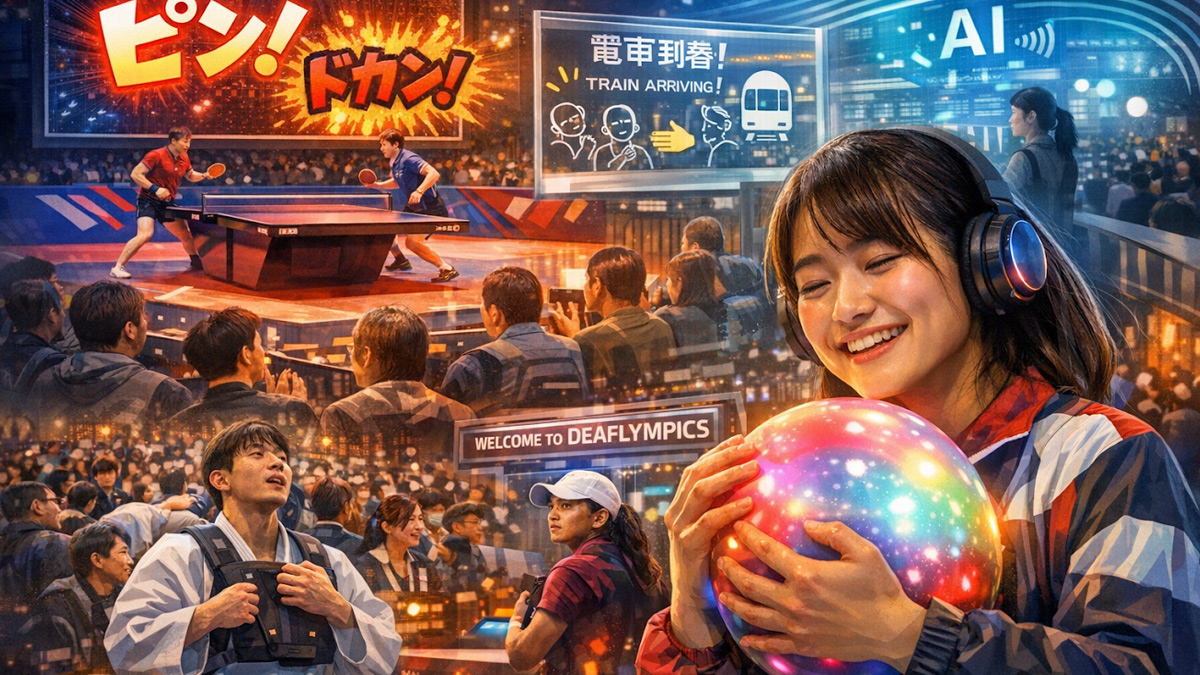
Inside the table tennis arena, giant screens above the court flash bold Japanese onomatopoeic characters in sync with every rally. Each smash, each spin, each decisive point gets its own visual explosion, drawn straight from the visual vocabulary of manga. For fans unfamiliar with the sport, the effect is instant and visceral. “For people who don’t play, or who are deaf, this helps them understand better,” says Ito Maki of Japan’s Deaf Table Tennis Association.
At the judo at Tokyo Budokan, the technology goes further. Spectators wore chest-mounted vibration devices made by Hapbeat, a firm better known for immersive music experiences. Microphones and sensors embedded in the mat translated every footstep, grip and throw into a distinct physical sensation. A shuffle produced a light tremor. A collision, something sharper. A full throw landed as a deep, unmistakable thud to the chest. “Each one was different,” said Eri Terada, a deaf judo fan. “I thought, wow, this is amazing. It’s so easy to understand.”
A former swimmer, Sano Akira, put it more simply: “The simplest thing is knowing when a match starts or ends. Since I can’t hear that, having this device notify me is really helpful.”
The devices proved a hit beyond their intended audience. Hearing spectators strapped them on and refused to take them off. “Even though I can hear, the device really conveyed the atmosphere,” said Nana Watanabe. “It felt like we could share the intensity together.” What began as an accessibility fix became something richer: a shared sensory language between deaf and hearing fans.
Beyond the arenas, 19 Tokyo metro stations were fitted with Toppan’s transparent sound-to-text screens. At Deaflympics Square, a Fujitsu display powered by artificial intelligence listened for train announcements, warning buzzers and background noise, converting them into text and sign language in real time. Onomatopoeia was woven in throughout, giving urgency and emotion to information that plain text cannot carry.
The most affecting moment came at a music event featuring Diksha Dagar, an Indian golfer, Deaflympics gold medallist and two-time Ladies European Tour champion. Dagar and others held Sound Hug devices, football-sized orbs made by Tokyo startup Pixie Dust Technologies, that pulsed light and vibrated in response to music. Not just beat and tempo, but emotion. “It tells us about the sound,” said Dagar. “So it’s interpreted for deaf people.”
The Deaflympics has for more than a century been the peak of elite competition for deaf athletes. Now it is also the world’s most ambitious laboratory for inclusive technology, and the lessons it is teaching are not confined to sport. When accessibility drives design rather than trailing behind it, everyone ends up with something better. The crowd at Tokyo did not just watch or listen. They felt it, saw it, held it in their hands. Sport has never sounded quite like this.