

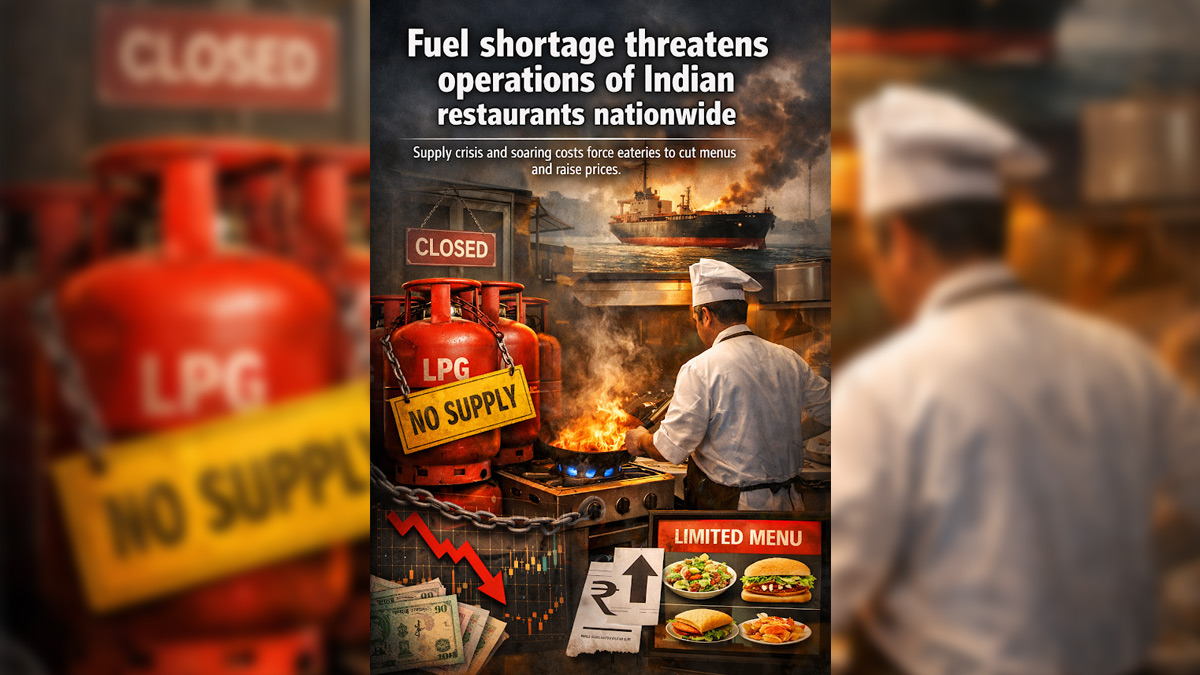
MUMBAI: As of March 2026, India’s food and restaurant industry is facing a significant operational crisis, primarily driven by the escalating conflict in West Asia (Middle East). While the earlier Russia-Ukraine war impacted global grain and oilseed prices, the current situation is hitting the “last mile” of the kitchen—the fuel.
Here is a breakdown of how these businesses are being affected:
1. The Commercial LPG Crisis
The most immediate and severe impact is a nationwide shortage of commercial LPG cylinders.
• Supply Prioritization: Because India imports a large portion of its LPG through the Strait of Hormuz, the conflict has disrupted shipping. The government has prioritized domestic (household) supply, leaving the commercial sector—restaurants, hotels, and canteens—with almost no stock.
• Operational Shutdowns: In cities like Bengaluru, Mumbai, Chennai, and Kolkata, many restaurants have been forced to suspend operations. The Bangalore Hotels Association recently announced a temporary cessation of operations for thousands of eateries due to the sudden supply cut.
• Menu Trimming: To conserve gas, restaurants are removing items that require long cooking times or high heat (like tandoori dishes). Some popular chains are only serving “limited menus” like salads and sandwiches.
2. Rising Input & Energy Costs
Even for businesses that manage to stay open, the cost of doing business has skyrocketed.
• Fuel surcharges: Commercial LPG prices saw an 8% hike in early March 2026 alone.
• Alternative fuel costs: Many bakeries and large kitchens are switching to diesel or electricity, which has increased production costs by approximately 25%.
• Logistics inflation: Higher crude oil prices (flirting with $100 per barrel) have increased transportation and delivery costs, directly impacting food delivery platforms and supply chains for fresh produce.
3. Supply Chain & Ingredient Shifts
Global conflicts have fundamentally altered what’s available in the pantry.
• Edible oil & grains: The long-standing Russia-Ukraine conflict has kept the prices of sunflower oil and wheat volatile. Indian restaurants have shifted toward alternative oils and local grains to maintain margins.
• Fertilizer shortages: Disruptions in fertilizer imports from West Asia are threatening the upcoming crop season, leading to fears of further food inflation for staples like cereals and vegetables.
4. Impact on QSR Giants
Large Quick Service Restaurant (QSR) chains like McDonald’s, Domino’s, and KFC are not immune.
• Margin pressure: These giants operate on high-volume, thin-margin models. The combination of LPG shortages and increased kitchen operating costs is forcing them to consider price hikes, which could dampen consumer demand.
• Transition to electric: There is a frantic push toward installing commercial induction cooktops and electric fryers, but this transition is expensive and limited by the electrical load capacity of older restaurant buildings.
The operational strain on restaurants is becoming visible across multiple fronts. A critical shortage of cooking fuel has forced several establishments to cut operating hours or temporarily shut down. Menus are being trimmed as high-gas dishes such as tandoor items and slow-cooked preparations are removed to conserve fuel. At the same time, rising costs are pushing restaurants to introduce price hikes or temporary “war surcharges” of around 10–15 per cent. In response to the fuel crunch, many businesses are also exploring a technological shift, rapidly moving towards induction-based and electric cooking solutions to reduce dependence on LPG.
As of March 11, 2026, the Indian QSR (Quick Service Restaurant) and food delivery sectors are under significant financial pressure. The escalating conflict in West Asia—marked by recent strikes on Iranian oil infrastructure and the blockade of the Strait of Hormuz—has triggered a domestic fuel crisis that is hitting restaurant margins hard.
Here is how the major players are being affected:
1. Stock market reactions
Investors have begun “de-risking” from food stocks as the government prioritizes domestic households over commercial gas users.
- Jubilant FoodWorks (Domino’s): Shares fell by 1.3% to 2% in recent sessions. As a high-volume business, any disruption in kitchen throughput directly impacts its quarterly EBITDA.
- Westlife Foodworld (McDonald’s West & South): The stock saw volatility, dropping up to 4.3% in a single session before a slight recovery.
- Sapphire Foods & Devyani International (KFC, Pizza Hut): Both have seen intraday declines of 1% to 2.5%. These companies are particularly vulnerable because deep-frying and high-heat ovens are energy-intensive and largely rely on LPG.
- Eternal & Swiggy: Food delivery platforms have slipped by 1.5% to 2.3%. If 20-50% of restaurants in Mumbai and Bengaluru shut down due to gas shortages, the volume of orders (and thus commission revenue) drops instantly.
2. The operational “Red Zone”
For an editor covering this, the key metric is the Supply Buffer. Most large chains operate with only 7 to 14 days of gas inventory.
- Revenue at risk: JM Financial estimates that if the LPG shortage persists for just 5 days, revenue per store could drop by 6%, while restaurant-level profit (EBITDA) could crash by 14-20% for the quarter.
- Cost inflation: Commercial LPG prices have already jumped by approximately Rs 115 per cylinder (an 8% month-on-month increase) in March alone.
3. Shift in business strategy
To survive the “gas-less” weeks, businesses are pivoting:
- The “cold menu” push: Expect to see more marketing around sandwiches, salads, and wraps that don’t require heavy cooking.
- Emergency electrification: Chains are rushing to buy commercial induction cooktops, though these cannot yet replace the high-volume output of gas fryers.
- Strategic hedging: The US recently granted India a 30-day waiver to process Russian oil already in transit to stabilize the market, but this primarily helps with petrol/diesel rather than the specific LPG used in kitchens.
Quick service restaurant chains appear particularly exposed to the fuel crunch. Jubilant FoodWorks, which operates Domino’s in India, faces a high level of disruption because its operations rely heavily on gas-powered ovens. Westlife Foodworld, which runs McDonald’s outlets in west and south India, is expected to face a moderate impact as its kitchens have a more diversified cooking setup. The pressure is far sharper for Devyani International and Sapphire Foods, which operate KFC and Pizza Hut outlets. Their heavy dependence on gas-based fryers makes them particularly vulnerable, placing them in the highest risk category if the commercial LPG shortage persists.